
Universal menu

  • Global
  • Regions
    • Africa
    • Americas and the Caribbean
    • Arab States
    • Asia and the Pacific
    • Europe and Central Asia
  • Knowledge
  • Data
  • Training
  • Transparency
UN Women - For all women and girls

Main Navigation-HQ

  • Who we are
    • About us
      • About UN Women
      • Business model
      • Guiding documents
      • Worldwide presence
    • Leadership
      • Governance structure
      • Executive leadership
      • Executive Board
      • Accountability
    • Work with us
      • Employment
      • Procurement
      • Calls for proposals
      • Contact us
      • UN Women Strategic Plan 2026–2029
      • UN Women Strategic Plan 2026–2029 - social media image
        UN Women Strategic Plan 2026–2029
  • What we do
    • Focus areas
      • Ending violence against women
      • Peace and security
      • Humanitarian action
      • Leadership and governance
      • Economic empowerment
      • Innovation and technology
      • Women with disabilities
      • Youth
      • HIV and AIDS
    • How we work
      • 2030 Agenda for Sustainable Development
      • Commission on the Status of Women
      • Gender parity in the UN system
      • Intergovernmental support
      • Partnerships
      • Research and data
      • Training Centre
      • Trust funds
      • UN system coordination
      • Gender Equality Accelerators
      • Gender Equality Accelerators artwork
        Gender Equality Accelerators
  • News and stories
    • Latest
      • News
      • Articles and explainers
      • In focus
    • Media center
      • Press materials
      • Media contacts
      • Explainer: Why are women so exhausted? Care work and the mental load
      • Two adults stand at a table changing diapers on baby dolls, with laundry hanging on a clothesline behind them in a home setting.
        Explainer: Why are women so exhausted? Care work and the mental load
      • Press release: Aid cuts dismantle women’s organizations working in humanitarian crises
      • A young Ugandan woman sits with another local woman to talk
        Press release: Aid cuts dismantle women’s organizations working in humanitarian crises
  • Digital library
    • Resources
      • Publications
      • Annual reports
      • Gender snapshot
      • Progress of the world’s women
      • World survey on the role of women in development
    • GenderTerm
      • GenderTerm
      • Reprint permissions
      • UN Women Highlights 2025–2026
      • A smiling woman.
        UN Women Highlights 2025–2026
      • Gender snapshot 2026
      • A diverse group of people represented as simplified silhouettes, arranged against a dark blue background.
        Gender snapshot 2026
  • Get involved
    • How to get involved
      • For ALL Women and Girls
      • International Women's Day
      • 16 Days of Activism to End Violence against Women and Girls
      • UNiTE! Campaign to End Violence against Women
      • Generation Equality
      • He for She
Ask AI
https://84e5cfacd5c7e99f9825edf344450c.1b.environment.api.powerplatform.com/powervirtualagents/botsbyschema/crad4_websiteQA/directline/token?api-version=2022-03-01-preview
1
-
Ask your question here
AI website assistant

Hello, how can I assist you?

AI chatbot responses may be incorrect. Always verify important information.

Donate button menu

Donate

Breadcrumb

  1. Home
  2. News and stories
  3. Feature story

Website survey

We want to know how we can improve your experience on this website. Completing this survey takes less than 5 minutes.

TAKE THE SURVEY
Feature

In Uganda, refugee women’s leadership drives inclusive humanitarian action

19 August 2022
  • Share to Facebook
  • Share to Twitter
  • Share to LinkedIn
  • Share to E-mail

19 August is World Humanitarian Day, an opportunity to honour the humanitarian community and the life-saving work they perform every day. This year’s theme, “it takes a village”, recognizes the importance of collective action in delivering humanitarian assistance—by professionals and volunteers, but also by crisis-affected people themselves.

When crises occur, women and girls disproportionately bear the impact. Their low participation in humanitarian response planning and decision making, however, limits their voices from being heard and their needs from being fully met. Empowering women to lead in crisis settings can help catalyse more robust humanitarian action that better addresses the needs of everyone.

Image
Women of Bidibidi Refugee Settlement celebrate a win in the RWC elections held in February 2022. Photo: UN Women/Athanasius Oguti

Over the past several years, refugee settlements in two districts of Uganda have provided a real-world demonstration of this trend.

Though women and children make up 81 per cent of the nearly 1.53 million refugees in Uganda, refugee settlement leadership has historically lacked women’s representation. Cultural barriers, coupled with  limited knowledge on rights and access to education, kept women from participating in decision-making processes. 

In 2018, UN Women began providing trainings for the women and youth of Adjumani and Yumbe districts, which host 30.1 per cent of Uganda’s total refugee population. The trainings included instruction in literacy, numeracy, women’s rights, leadership and life skills development, public speaking, debating and radio presentation. The results were striking.

“Before I participated in the leadership training, I was a shy person. I could not speak up because of fear”, says Joy Aiba, a South Sudanese refugee living in Bidibidi Refugee Settlement in Yumbe District. Now, she feels empowered to make her voice heard within settlement leadership.

Ugandan refugee settlements are governed by Refugee Welfare Committees (RWCs), with committee members directly elected by the refugee community under the supervision of the Office of the Prime Minister (OPM). Elections of RWCs take place every two years. While the guidelines for RWCs provide for 30 per cent refugee representation, women had not been coming forth to run in the elections and take up leadership positions.

That’s changed since the trainings. “The leadership skills have enabled me to speak up for women in meetings”, Aiba says. “Right now, I am the RWC Chairperson for my village in Zone I. In Zone I and II, most leaders are now women”.

Aiba’s experience is echoed by other leadership training participants. “From the training we realized that as refugee women we actually have a right to contest any position on the RWC”, says Rose Aliyah, a South Sudanese refugee woman living in Pagirinya Settlement in Adjumani district. This gave me the courage to contest the position of Chairperson of RWC I in my village. My win encouraged more women to run for leadership”.

Image
Refugee women learn participatory communication skills using video. Photo: UN Women

And they’ve been winning. In the districts of Yumbe and Adjumani, women’s representation on RWCs has increased from 10 per cent in 2017 to 48 per cent and 54 per cent respectively in 2022, according to data from the OPM.

Lily Anek Okumu, a refugee woman living in Pagirinya Settlement in Adjumani district, broke barriers when she competed against four male candidates for the highest office in refugee administration and management leadership. “Competing for this position made me feel that I am representing many women that fear to express themselves”, Anek says. “Most women don’t know they have a right to leadership and decision making”. Though she came in third, Anek’s run helped empower other women in Pagirinya Settlement to actively participate in leadership at all fronts.

“Women have emerged the best in this year’s RWC elections because of the support from UN Women”, says Draleru Josephine, Community Services Officer at Adjumani Refugee Desk. “With UN Women support, large scale campaigns and civic education were conducted, which raised awareness on the rights, roles and responsibilities of women”. The 2022 election saw more women competing for RWC positions beyond those of Vice Chairperson and Secretary, the two positions usually reserved for women.

With more refugee women taking on leadership roles in the settlements, women’s access to services has improved. They have been able to work together within their communities to identify the issues limiting their access to services and refer these issues to relevant authorities for follow up. Women have taken on leadership roles as translators, court interpreters and community mobilisers and facilitators; they serve on parent teacher committees, food distribution committees, village health committees and water management committees.

From now through 2025, UN Women aims to expand the leadership trainings to two more districts—Terego and Kyegegwa—with the goal of building the leadership capacity of 2,000 women leaders. A mentorship program will also benefit 340 women leaders at the subnational and local level.

As humanitarian crises continue to test our collective abilities to protect and care for one another, women’s leadership will remain central to our success. Refugee women are key drivers of effective, inclusive humanitarian action, and it’s up to all of us to ensure they have the resources and support they need.

Leadership trainings in Adjumani, Yumbe, Terego and Kyegegwa are part of the Leadership, Empowerment, Access and Protection (LEAP) Programme, implemented with funding from the Government of Norway and through partnerships with the OPM, UNHCR, Refugee Law Project and Care International.  

Topics

  • Access to basic services
  • Humanitarian action
  • Crisis response and recovery
  • Leadership and political participation
  • Africa
  • Uganda

Related content

Image
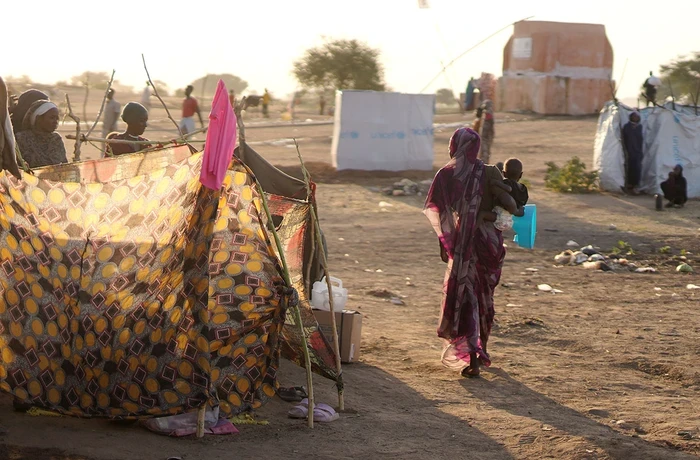
A woman holding a child, facing away from the camera, walks past makeshift tents
Feature

“I feel like I am a warrior”: Sudanese women fight for peace on the front lines of war

23 October 2026
“I feel like I am a warrior”: Sudanese women fight for peace on the front lines of war
Image
UNWomen_Placeholder
Press briefing

Nine in 10 organizations say trauma persists among women and girls displaced from El Fasher a year after its fall

23 October 2026
Nine in 10 organizations say trauma persists among women and girls displaced from El Fasher a year after its fall
Image
UNWomen_Placeholder
Press briefing

The scale of destruction and suffering after three years of war in Gaza can be measured in the lives of women and girls

9 October 2026
The scale of destruction and suffering after three years of war in Gaza can be measured in the lives of women and girls

Footer menu-HQ

  • News and stories
  • Resources
  • What we do
  • How we work
  • Where we are
  • Partnerships
  • Employment
  • Procurement
  • Contact us
  • Executive Board
  • Commission on the Status of Women

Donate button menu [Footer tablet]

  • Donate

Donate button menu [Footer]

  • Donate

Social media menu

  • Facebook
  • Twitter
  • LinkedIn
  • Flickr
  • YouTube
  • Instagram
UN Women - For all women and girls

Footer bottom [Menu]

  • Copyright
  • Information security
  • Privacy notice
  • Report wrongdoing
  • Terms of use
Share this page
  • Share to Facebook
  • Share to Twitter
  • Share to LinkedIn
  • Share to E-mail

Or copy link