
Universal menu

  • Global
  • Regions
    • Africa
    • Americas and the Caribbean
    • Arab States
    • Asia and the Pacific
    • Europe and Central Asia
  • Knowledge
  • Data
  • Training
  • Transparency
UN Women - For all women and girls

Main Navigation-HQ

  • Who we are
    • About us
      • About UN Women
      • Business model
      • Guiding documents
      • Worldwide presence
    • Leadership
      • Governance structure
      • Executive leadership
      • Executive Board
      • Accountability
    • Work with us
      • Employment
      • Procurement
      • Calls for proposals
      • Contact us
      • UN Women Strategic Plan 2026–2029
      • UN Women Strategic Plan 2026–2029 - social media image
        UN Women Strategic Plan 2026–2029
  • What we do
    • Focus areas
      • Ending violence against women
      • Peace and security
      • Humanitarian action
      • Leadership and governance
      • Economic empowerment
      • Innovation and technology
      • Women with disabilities
      • Youth
      • HIV and AIDS
    • How we work
      • 2030 Agenda for Sustainable Development
      • Commission on the Status of Women
      • Gender parity in the UN system
      • Intergovernmental support
      • Partnerships
      • Research and data
      • Training Centre
      • Trust funds
      • UN system coordination
      • Gender Equality Accelerators
      • Gender Equality Accelerators artwork
        Gender Equality Accelerators
  • News and stories
    • Latest
      • News
      • Articles and explainers
      • In focus
    • Media center
      • Press materials
      • Media contacts
      • Explainer: Why are women so exhausted? Care work and the mental load
      • Two adults stand at a table changing diapers on baby dolls, with laundry hanging on a clothesline behind them in a home setting.
        Explainer: Why are women so exhausted? Care work and the mental load
      • Press release: Aid cuts dismantle women’s organizations working in humanitarian crises
      • A young Ugandan woman sits with another local woman to talk
        Press release: Aid cuts dismantle women’s organizations working in humanitarian crises
  • Digital library
    • Resources
      • Publications
      • Annual reports
      • Gender snapshot
      • Progress of the world’s women
      • World survey on the role of women in development
    • GenderTerm
      • GenderTerm
      • Reprint permissions
      • UN Women Highlights 2025–2026
      • A smiling woman.
        UN Women Highlights 2025–2026
      • Gender snapshot 2026
      • A diverse group of people represented as simplified silhouettes, arranged against a dark blue background.
        Gender snapshot 2026
  • Get involved
    • How to get involved
      • For ALL Women and Girls
      • International Women's Day
      • 16 Days of Activism to End Violence against Women and Girls
      • UNiTE! Campaign to End Violence against Women
      • Generation Equality
      • He for She
Ask AI
https://84e5cfacd5c7e99f9825edf344450c.1b.environment.api.powerplatform.com/powervirtualagents/botsbyschema/crad4_websiteQA/directline/token?api-version=2022-03-01-preview
1
-
Ask your question here
AI website assistant

Hello, how can I assist you?

AI chatbot responses may be incorrect. Always verify important information.

Donate button menu

Donate

Breadcrumb

  1. Home
  2. News and stories
  3. Press briefing

Website survey

We want to know how we can improve your experience on this website. Completing this survey takes less than 5 minutes.

TAKE THE SURVEY
Press briefing

The scale of destruction and suffering after three years of war in Gaza can be measured in the lives of women and girls

Remarks by UN Women Chief of Humanitarian Action Sofia Calltorp – to whom quoted text may be attributed – at today’s press briefing at the Palais des Nations in Geneva.

9 October 2026
  • Share to Facebook
  • Share to Twitter
  • Share to LinkedIn
  • Share to E-mail

[As prepared. Also available in Arabic.]

Geneva – The scale of suffering in Gaza can be measured in the lives of women and girls.

UN Women estimates that nearly 50,000 women and girls have been killed or severely injured since October 2023 – more than 38,000 killed and 11,700 left with injuries so severe that they now live with lifelong disabilities.

This is equivalent to one in every 21 women and girls in Gaza.

Most of the casualties were recorded during the first two years of the war. But women and girls continue to be killed and injured even after the ceasefire agreement entered into effect a year ago. Two hundred seventy-seven women and girls have been killed in Gaza since October 2025.

Behind every number is a life: a woman with hopes and ambitions, a mother caring for her children, a daughter, a spouse and friend, a women contributing to her family and community.

Earlier this week, we spoke to a mother about her daughter, Amani, a 35-year-old psychologist and mother of four who was killed in an airstrike alongside her children. She told us that Amani had dreamed of watching her children grow and building a future with them. She also stressed that she did not want her daughter’s story to be reduced to the day she was killed.

In her own words, “We want the world to know who Amani was in life: an ambitious Palestinian woman, a devoted mother, a psychology professional, a woman who loved life and made a difference in the lives of others.”

Over the past three years, the Israeli Defense Forces have issued more than 150 evacuation and movement orders. Nearly one million women and girls have been forced from their homes.

Today, almost every woman and girl in Gaza remains displaced, with the majority living in tents or among the ruins of their homes.

Hayam is one of them. She is a programme coordinator at the Women’s Affairs Centre in Gaza, one of UN Women’s partners providing a lifeline to women and girls in Gaza. Hayam lives in a tent. Her wishes are simple: a wall to lean against, a door to close, and the safety of her family and her team.

The war has also reshaped family life. The number of women heading households has doubled over the past three years. Women now head one in four households in Gaza, often while facing deeper poverty, repeated displacement and the responsibility of caring for their families with increasingly limited resources.

Nour is one of them. Her home was destroyed, and her husband, a nurse, was detained. She has neither seen nor heard from him since. She told us that, at times, she becomes so lost in thought that she is unable to respond even to her children.

Women’s organizations are lifelines to women, girls and their families, but funding cuts are threatening their ability to serve those who need them.

UN Women surveyed 14 women’s organizations working in Gaza and the occupied West Bank. Thirteen said that the needs of women and girls have increased since funding cuts swept through the aid sector in 2025. The same number said that they no longer have capacity to meet those needs.

The consequences are immediate: nearly two thirds of the organizations surveyed said they have been forced to put women and girls on waiting lists or turn them away altogether.

All organizations surveyed had seen an increase in gender-based violence, poverty, and mental health distress since 2025. Thirteen of the 14 organizations had seen an increase in child marriage.

UN Women is on the ground in Gaza. We are working with women-led and women’s rights organizations to deliver life-saving and critical assistance to those most in need.

We document the experiences and perspectives of women and girls in Gaza and use these insights to help ensure the humanitarian response reflects and responds to their needs.

What we have found is a horrific amount of collective suffering, an immense amount of pain, and a level of resilience and strength that no woman should have to bear. Women are keeping their families afloat, trying to hold on to the everyday things that make life feel normal, while rebuilding what has been lost.

We call for the ceasefire in Gaza to be fully implemented, international law to be upheld, and accountability for violations, alongside the protection of women and girls.

Topics

  • Humanitarian action
  • Peace and security
  • Conflict, war
  • Post-conflict recovery
  • Arab States/North Africa
  • Palestine, State of

Related content

Image
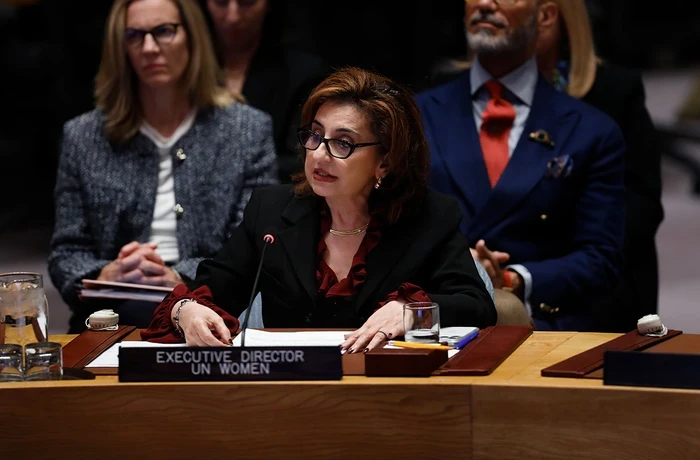
UN Under-Secretary-General and UN Women Executive Director Sima Bahous delivers remarks to the Security Council open debate on women and peace and security, UN headquarters, 27 October 2026. Photo: UN Women/Ryan Brown.
Speech

Speech: Do we have the courage to share power, the resolve to invest in women’s leadership, and the political will to turn our commitments into action?

27 October 2026
Speech: Do we have the courage to share power, the resolve to invest in women’s leadership, and the political will to turn our commitments into action?
Image
UNWomen_Placeholder
Press briefing

The UN Secretary General’s report on Women, Peace, and Security

26 October 2026
The UN Secretary General’s report on Women, Peace, and Security
Image
UNWomen_Placeholder
Press release

Women and girls’ death toll in armed conflict doubles since 2021

26 October 2026
Women and girls’ death toll in armed conflict doubles since 2021

Footer menu-HQ

  • News and stories
  • Resources
  • What we do
  • How we work
  • Where we are
  • Partnerships
  • Employment
  • Procurement
  • Contact us
  • Executive Board
  • Commission on the Status of Women

Donate button menu [Footer tablet]

  • Donate

Donate button menu [Footer]

  • Donate

Social media menu

  • Facebook
  • Twitter
  • LinkedIn
  • Flickr
  • YouTube
  • Instagram
UN Women - For all women and girls

Footer bottom [Menu]

  • Copyright
  • Information security
  • Privacy notice
  • Report wrongdoing
  • Terms of use
Share this page
  • Share to Facebook
  • Share to Twitter
  • Share to LinkedIn
  • Share to E-mail

Or copy link