Universal menu

  • Global
  • Regions
    • Africa
    • Americas and the Caribbean
    • Arab States
    • Asia and the Pacific
    • Europe and Central Asia
  • Knowledge
  • Data
  • Training
  • Transparency
UN Women - For all women and girls

Main Navigation-HQ

  • Who we are
    • About us
      • About UN Women
      • Business model
      • Guiding documents
      • Worldwide presence
    • Leadership
      • Governance structure
      • Executive leadership
      • Executive Board
      • Accountability
    • Work with us
      • Employment
      • Procurement
      • Calls for proposals
      • Contact us
      • UN Women Strategic Plan 2026–2029
      • UN Women Strategic Plan 2026–2029 - social media image
        UN Women Strategic Plan 2026–2029
  • What we do
    • Focus areas
      • Ending violence against women
      • Peace and security
      • Humanitarian action
      • Leadership and governance
      • Economic empowerment
      • Innovation and technology
      • Women with disabilities
      • Youth
      • HIV and AIDS
    • How we work
      • 2030 Agenda for Sustainable Development
      • Commission on the Status of Women
      • Gender parity in the UN system
      • Intergovernmental support
      • Partnerships
      • Research and data
      • Training Centre
      • Trust funds
      • UN system coordination
      • Gender Equality Accelerators
      • Gender Equality Accelerators artwork
        Gender Equality Accelerators
  • News and stories
    • Latest
      • News
      • Articles and explainers
      • In focus
    • Media center
      • Press materials
      • Media contacts
      • Explainer: Why are women so exhausted? Care work and the mental load
      • Two adults stand at a table changing diapers on baby dolls, with laundry hanging on a clothesline behind them in a home setting.
        Explainer: Why are women so exhausted? Care work and the mental load
      • Press release: Aid cuts dismantle women’s organizations working in humanitarian crises
      • A young Ugandan woman sits with another local woman to talk
        Press release: Aid cuts dismantle women’s organizations working in humanitarian crises
  • Digital library
    • Resources
      • Publications
      • Annual reports
      • Gender snapshot
      • Progress of the world’s women
      • World survey on the role of women in development
    • GenderTerm
      • GenderTerm
      • Reprint permissions
      • UN Women Highlights 2025–2026
      • A smiling woman.
        UN Women Highlights 2025–2026
      • Gender snapshot 2026
      • A diverse group of people represented as simplified silhouettes, arranged against a dark blue background.
        Gender snapshot 2026
  • Get involved
    • How to get involved
      • For ALL Women and Girls
      • International Women's Day
      • 16 Days of Activism to End Violence against Women and Girls
      • UNiTE! Campaign to End Violence against Women
      • Generation Equality
      • He for She
Ask AI
https://84e5cfacd5c7e99f9825edf344450c.1b.environment.api.powerplatform.com/powervirtualagents/botsbyschema/crad4_websiteQA/directline/token?api-version=2022-03-01-preview
1
-
Ask your question here
AI website assistant

Hello, how can I assist you?

AI chatbot responses may be incorrect. Always verify important information.

Donate button menu

Donate

Breadcrumb

  1. Home
  2. News and stories
  3. Press briefing

Website survey

We want to know how we can improve your experience on this website. Completing this survey takes less than 5 minutes.

TAKE THE SURVEY
Press briefing

Nine in 10 organizations say trauma persists among women and girls displaced from El Fasher a year after its fall

Remarks by Anna Mutavati, UN Women Regional Director for East and Southern Africa, to whom quoted text may be attributed, at press briefing at the Palais des Nations in Geneva

23 October 2026
  • Share to Facebook
  • Share to Twitter
  • Share to LinkedIn
  • Share to E-mail

[As prepared]

Khartoum/Geneva/Nairobi – “A year ago, the world watched as atrocities in El Fasher, North Darfur, were livestreamed to our phones.

A year later, the impact of violence, and the risk of renewed violence remains.

And across Sudan, drone attacks are increasing across Blue Nile State, Khartoum, West Kordofan, Gedaref State, and the Khashm al-Girba area in Kassala State. Most of those killed or injured are women and children. Many had already fled violence, including sexual violence, seeking safety or attempting to return home.

The images that emerged from El Fasher a year ago offered a window into the extent to which violence in Sudan is inflicted on women and girls – gang raped, beaten, humiliated and robbed of their belongings. Some were taken and have not been seen since.

UN Women conducted a survey of 50 women’s organizations supporting people displaced from El Fasher. I am sharing the results with you today.

One year on, the scars of the violence in El Fasher have not faded. Women and girls continue to live with the trauma of sexual violence, the disappearance of their daughters, sisters, mothers, husbands and sons, the killing of family members, and the loss of their homes and livelihoods.

Psychological distress, sleepless nights and unsafe living conditions are part of daily life, and so is the struggle to find food, water, and healthcare.

Safety is mostly out of reach.

Nine in ten organizations we surveyed described displaced women and girls living in unsafe living conditions. Forty-nine of 50 organizations observed signs of psychological distress among women and girls displaced from El Fasher, and 45 of them – 90 per cent – reported that this distress persists today. Forty-eight of 50 organizations report women being unable to sleep because of the trauma they have experienced.

Around two-thirds of organizations we spoke to were aware of women or girls who disappeared during or after the fall of El Fasher.

The needs of women and girls are immense but access to support is severely limited.

Forty-three of the 50 organizations had encountered women or girls in distress who had received no mental health, psychosocial or legal support since fleeing, and nearly half said few or none of the women they work with could access such support.

Critical service providers, including those providing mental health and health care are facing threats of arrest and harassment while delivering services – all in the absence of protection.

Some people have started to return to El Fasher, but the fear of violence is constant.

According to the 2026 Sudan Multi-Sectoral Needs Assessment by IOM[1], 84 per cent of 117 households surveyed in Al Fasher said women avoid marketplaces, two thirds avoid collecting firewood, while half avoid social, community or religious spaces.

We are hearing reports of hospitals lacking doctors and medicines needed to function beyond emergency cases. Food and access to other basic goods are also scarce.

Across Sudan, we are seeing an increase in drone attacks on displacement camps, markets and other civilian infrastructure, leaving those fleeing with no safe space to turn and with total disregard for international humanitarian law.

Attacks on civilian infrastructure kill and injure civilians and add to the difficulties they face in accessing essential services and livelihoods, and force more people to flee. The UN Fact-Finding Mission found that 80 per cent of hospitals in conflict-affected areas are not functioning, causing a spike in maternal deaths and reducing women’s access to sexual and reproductive health care.

But there is another side to this war that is rarely told. The emergence of women across Sudan as front-line responders, caregivers, mediators, and peacebuilders. They are doing so as the institutions around them have collapsed, and as persistent underfunding and insecurity threaten their work. Supported by UN Women, these women-led organizations reach communities others cannot, and are a lifeline to women and girls, their families and communities.

Across Sudan, UN Women provides lifesaving support to women and girls and invests in women’s leadership – which is critical for peace, security, and recovery. We work with grassroots women’s networks to strengthen their capacity for dialogue, negotiation, conflict analysis, mediation and advocacy, enabling women to resolve disputes, reduce tensions and influence the decisions shaping their communities.

As we mark 26 years since the adoption of Security Council resolution 1325, which laid the foundation for the Women, Peace and Security agenda, the experiences of women in Sudan, and their role in the country’s peace and security are central to this commitment.

UN Women calls for the protection of civilians, accountability for perpetrators of violence, and compliance with international humanitarian and human rights law. Women and girls must have access to essential services and resources and participate meaningfully in decisions about peace and their country’s future, with sustained support for the women leaders and organizations working on the front lines.”  
[1] IOM Multi-Sectoral Needs Assessment 2026

Learn more

4
10
UNWomen_Placeholder
Press release

Middle East escalation could leave 11.7 million more women and girls facing food insecurity by end-2026

2 October 2026
Sudanese women
Feature story

How Sudanese women uplift one another – and their communities – amid war

15 September 2026
A young woman poses for a portrait while wearing a UN Women vest
Feature story

Serving through crisis: UN Women’s humanitarian workers on what keeps them going

17 August 2026
UNWomen_Placeholder
Statement

UN Women statement: Drone attacks by day and sexual violence by night leave no safe window for women and girls to collect water amidst rainy season in Sudan’s El Obeid

24 July 2026
Woman wearing a white headscarf and glasses sits at a desk, writing in a notebook beside a tablet.
Feature story

Who are the women working on the frontlines of Sudan war’s sexual violence epidemic?

18 June 2026
Image
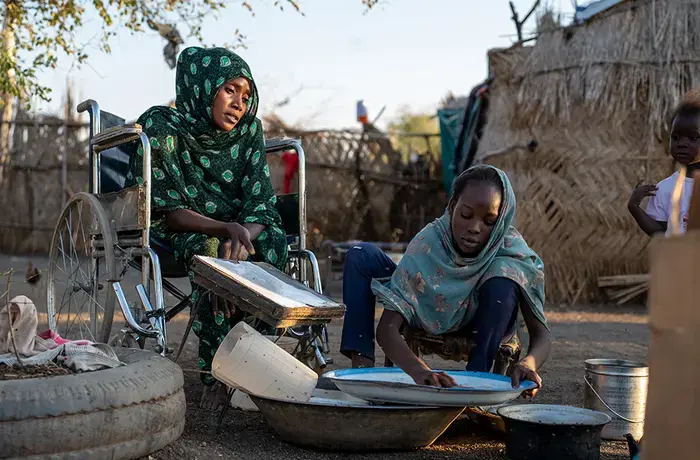
A woman in a wheelchair sits outdoors beside a girl washing dishes, with a child standing nearby.
FAQs

How war impacts women and girls: A simple explainer on gender and conflict

26 October 2026
UNWomen_Placeholder
Press briefing

Remarks by Anna Mutavati, UN Women Regional Director for East and Southern Africa, on Sudan’s war on women and girls, as conflict enters fourth year

14 April 2026
On 10 December 2024 in Sudan, Omnia [NAME CHANGED] peers through the window during a visit to a women’s organization. Displaced from her home due to fighting and threats, she lives with the trauma of being kidnapped, threatened, beaten and raped by armed men. To support her healing, Omnia is receiving mental health and psychosocial support from a women’s organization. Photo: UNICEF/UNI754435/Tess Ingram
Press release

Sudan's war on women: The number of people in need of sexual violence support quadruples as abuse of women and girls becomes the blueprint of war, three years on

14 April 2026
Image
UN Women team members listen to women at the Alazhri Gathering Site in Port Sudan during a day of emergency assistance distribution. Photo: UN Women/Ekram Hamad Fadlalla.
FAQs

How women and girls are being targeted in the war in Sudan

14 April 2026
Image
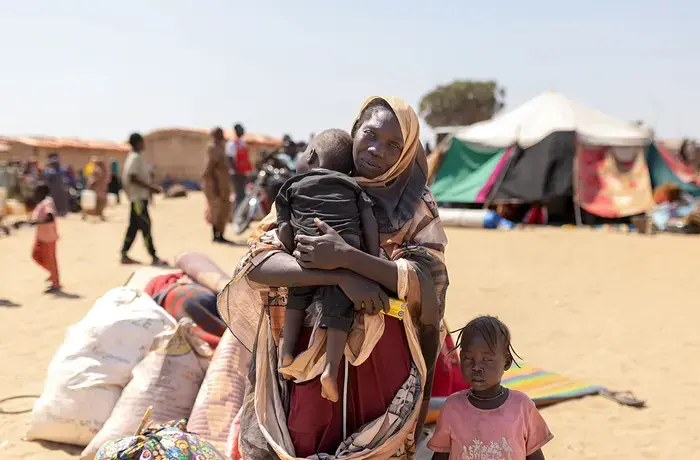
A woman holds a child and looks at the camera, with belongings behind her and another child beside her.
In focus

Sudan war: Inside the world’s worst humanitarian and protection crisis for women and girls

23 October 2026

Topics

  • 2030 Agenda for Sustainable Development
  • Water
  • Ending violence against women and girls
  • Health
  • Humanitarian action
  • Peace and security
  • Conflict, war
  • Sexual violence in conflict
  • UN Security Council resolutions
  • UN Security Council resolution 1325
  • Africa
  • Sudan

Related content

Image
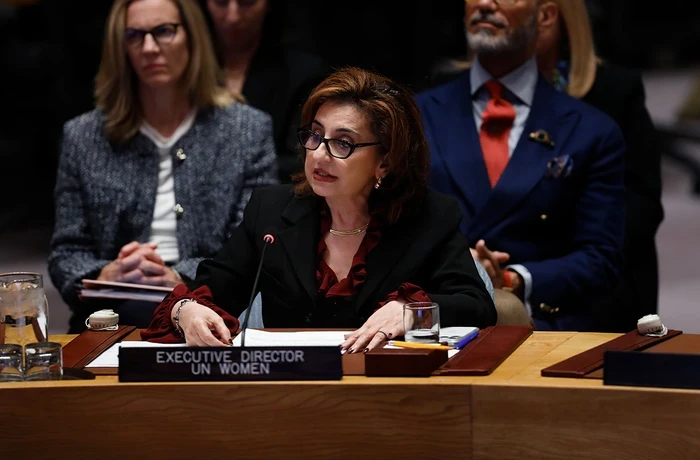
UN Under-Secretary-General and UN Women Executive Director Sima Bahous delivers remarks to the Security Council open debate on women and peace and security, UN headquarters, 27 October 2026. Photo: UN Women/Ryan Brown.
Speech

Speech: Do we have the courage to share power, the resolve to invest in women’s leadership, and the political will to turn our commitments into action?

27 October 2026
Speech: Do we have the courage to share power, the resolve to invest in women’s leadership, and the political will to turn our commitments into action?
Image
UNWomen_Placeholder
Press briefing

The UN Secretary General’s report on Women, Peace, and Security

26 October 2026
The UN Secretary General’s report on Women, Peace, and Security
Image
UNWomen_Placeholder
Press release

Women and girls’ death toll in armed conflict doubles since 2021

26 October 2026
Women and girls’ death toll in armed conflict doubles since 2021

Footer menu-HQ

  • News and stories
  • Resources
  • What we do
  • How we work
  • Where we are
  • Partnerships
  • Employment
  • Procurement
  • Contact us
  • Executive Board
  • Commission on the Status of Women

Donate button menu [Footer tablet]

  • Donate

Donate button menu [Footer]

  • Donate

Social media menu

  • Facebook
  • Twitter
  • LinkedIn
  • Flickr
  • YouTube
  • Instagram
UN Women - For all women and girls

Footer bottom [Menu]

  • Copyright
  • Information security
  • Privacy notice
  • Report wrongdoing
  • Terms of use
Share this page
  • Share to Facebook
  • Share to Twitter
  • Share to LinkedIn
  • Share to E-mail

Or copy link