Universal menu

  • Global
  • Regions
    • Africa
    • Americas and the Caribbean
    • Arab States
    • Asia and the Pacific
    • Europe and Central Asia
  • Knowledge
  • Data
  • Training
  • Transparency
UN Women - For all women and girls

Main Navigation-HQ

  • Who we are
    • About us
      • About UN Women
      • Business model
      • Guiding documents
      • Worldwide presence
    • Leadership
      • Governance structure
      • Executive leadership
      • Executive Board
      • Accountability
    • Work with us
      • Employment
      • Procurement
      • Calls for proposals
      • Contact us
      • UN Women Strategic Plan 2026–2029
      • UN Women Strategic Plan 2026–2029 - social media image
        UN Women Strategic Plan 2026–2029
  • What we do
    • Focus areas
      • Ending violence against women
      • Peace and security
      • Humanitarian action
      • Leadership and governance
      • Economic empowerment
      • Innovation and technology
      • Women with disabilities
      • Youth
      • HIV and AIDS
    • How we work
      • 2030 Agenda for Sustainable Development
      • Commission on the Status of Women
      • Gender parity in the UN system
      • Intergovernmental support
      • Partnerships
      • Research and data
      • Training Centre
      • Trust funds
      • UN system coordination
      • Gender Equality Accelerators
      • Gender Equality Accelerators artwork
        Gender Equality Accelerators
  • News and stories
    • Latest
      • News
      • Articles and explainers
      • In focus
    • Media center
      • Press materials
      • Media contacts
      • Explainer: Why are women so exhausted? Care work and the mental load
      • Two adults stand at a table changing diapers on baby dolls, with laundry hanging on a clothesline behind them in a home setting.
        Explainer: Why are women so exhausted? Care work and the mental load
      • Press release: Aid cuts dismantle women’s organizations working in humanitarian crises
      • A young Ugandan woman sits with another local woman to talk
        Press release: Aid cuts dismantle women’s organizations working in humanitarian crises
  • Digital library
    • Resources
      • Publications
      • Annual reports
      • Gender snapshot
      • Progress of the world’s women
      • World survey on the role of women in development
    • GenderTerm
      • GenderTerm
      • Reprint permissions
      • UN Women Highlights 2025–2026
      • A smiling woman.
        UN Women Highlights 2025–2026
      • Gender snapshot 2026
      • A diverse group of people represented as simplified silhouettes, arranged against a dark blue background.
        Gender snapshot 2026
  • Get involved
    • How to get involved
      • For ALL Women and Girls
      • International Women's Day
      • 16 Days of Activism to End Violence against Women and Girls
      • UNiTE! Campaign to End Violence against Women
      • Generation Equality
      • He for She
Ask AI
https://84e5cfacd5c7e99f9825edf344450c.1b.environment.api.powerplatform.com/powervirtualagents/botsbyschema/crad4_websiteQA/directline/token?api-version=2022-03-01-preview
1
-
Ask your question here
AI website assistant

Hello, how can I assist you?

AI chatbot responses may be incorrect. Always verify important information.

Donate button menu

Donate

Breadcrumb

  1. Home
  2. News and stories
  3. In the words of ...

Website survey

We want to know how we can improve your experience on this website. Completing this survey takes less than 5 minutes.

TAKE THE SURVEY
In the words of ...

In the words of Alice Ledu: “I feel happy that I can contribute to my family’s well-being.”

24 January 2023
  • Share to Facebook
  • Share to Twitter
  • Share to LinkedIn
  • Share to E-mail

Alice Ledu is a South Sudanese refugee living in Bidi Bidi Refugee Settlement in Yumbe District, Northern Uganda. Through UN Women’s Second Chance Education Programme, implemented with financial support from the Government of Japan, she gained life-changing vocational skills. Now a business owner, Alice is paying it forward by helping to train and mentor a new generation of young people.  

Access to education can transform the lives of women and girls, generating new possibilities for individuals, families and communities. Yet as of 2022 nearly 130 million girls worldwide were not enrolled in formal schooling, over half of whom resided in crisis-affected countries. On 24 January, UN Women marks International Day of Education by highlighting the central role of education in furthering women’s empowerment—and the critical need to ensure its universal availability.  

Image
Alice Ledu in Bidi Bidi Settlement attending to the tailoring enterprise that she started using proceeds from her catering business skills. Photo: UN Women/Jeroen van Loon

A year ago, I would wake up to a life filled with anxiety and migraines every day. At night I wondered what I would do the next day to earn an income. At dawn I roamed through the refugee settlement and host communities looking for a casual job so that I could earn an income. This was my life since September 2016 when I started living here in Zone 2, Bidi Bidi Refugee Settlement in Yumbe District [in northern Uganda]. I live here with my husband and four children. 

With no money and no job, I depended only on the rations provided to the refugees. This meant no change of diet, access to basic necessities was difficult and I could not afford decent items including bedding for my family. Even when I joined a savings group it was difficult for me to keep up to date with my savings. I could only save on days I managed to get a cash for work opportunity. With cash for work I would get paid and I would use part of the money to save and spend a portion to meet basic needs for my family. But cash for work opportunities are rare in the refugee settlement. 

My story changed for the better when UN Women’s implementing partner, CARE International, identified me as a beneficiary for the second chance education programme. I applied and was selected to do the vocational course of my choice—catering and hotel management. I participated in a rigorous training for three months and earned a certificate in catering conferred by the Uganda Business and Technical Examinations Board (UBTEB) under the Ministry of Education and Sports. In April 2022, I was able to open God is Able restaurant in Zone 2 in Bidi Bidi Refugee Settlement. I prepare local dishes mostly targeting people in the market. I am assured of at least 20 customers per day. 

Having this certificate has opened doors for me. This year, one of the humanitarian organizations that is implementing programmes in Bidi Bidi called for proposals from organizations or individuals that can offer vocational training to young people in catering. I submitted my proposal and I was selected to train 35 young people. I am training and mentoring them in catering, baking and hotel management.  

Before coming to Uganda, I had trained in tailoring but I did not have a sewing machine to practice my skills. With this additional income I have been able to procure two sewing machines and I am now employing one person to attend to this tailoring enterprise. My restaurant usually serves breakfast and lunch so I am able to use my evenings to attend to the tailoring business. 

My life now is busy. I am occupied and no longer have those negative thoughts that caused me stress and headaches. I feel happy that I can contribute to my family’s well-being. My dream is to further my education and attain a diploma in catering and expand my restaurant to become a big hotel. 

Topics

  • Economic empowerment
  • Education
  • Africa
  • Uganda
  • South Sudan

Related content

Image
UNWomen_Placeholder
Statement

UN Women statement for the International Day of Care and Support 2026

28 October 2026
UN Women statement for the International Day of Care and Support 2026
Image
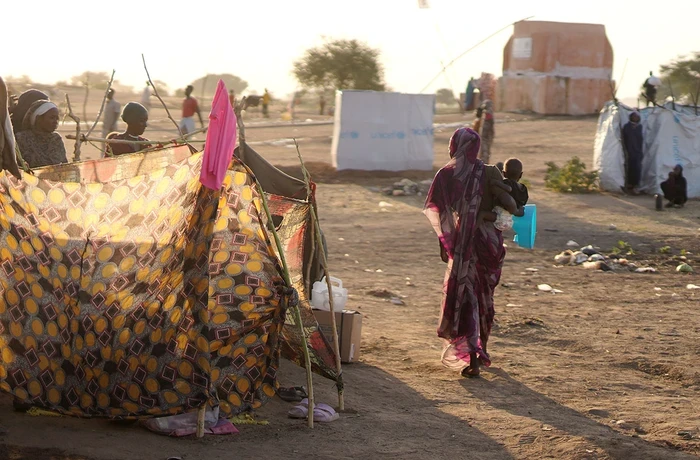
A woman holding a child, facing away from the camera, walks past makeshift tents
Feature

“I feel like I am a warrior”: Sudanese women fight for peace on the front lines of war

23 October 2026
“I feel like I am a warrior”: Sudanese women fight for peace on the front lines of war
Image
UNWomen_Placeholder
Press briefing

Nine in 10 organizations say trauma persists among women and girls displaced from El Fasher a year after its fall

23 October 2026
Nine in 10 organizations say trauma persists among women and girls displaced from El Fasher a year after its fall

Footer menu-HQ

  • News and stories
  • Resources
  • What we do
  • How we work
  • Where we are
  • Partnerships
  • Employment
  • Procurement
  • Contact us
  • Executive Board
  • Commission on the Status of Women

Donate button menu [Footer tablet]

  • Donate

Donate button menu [Footer]

  • Donate

Social media menu

  • Facebook
  • Twitter
  • LinkedIn
  • Flickr
  • YouTube
  • Instagram
UN Women - For all women and girls

Footer bottom [Menu]

  • Copyright
  • Information security
  • Privacy notice
  • Report wrongdoing
  • Terms of use
Share this page
  • Share to Facebook
  • Share to Twitter
  • Share to LinkedIn
  • Share to E-mail

Or copy link