Universal menu

  • Global
  • Regions
    • Africa
    • Americas and the Caribbean
    • Arab States
    • Asia and the Pacific
    • Europe and Central Asia
  • Knowledge
  • Data
  • Training
  • Transparency
UN Women - For all women and girls

Main Navigation-HQ

  • Who we are
    • About us
      • About UN Women
      • Business model
      • Guiding documents
      • Worldwide presence
    • Leadership
      • Governance structure
      • Executive leadership
      • Executive Board
      • Accountability
    • Work with us
      • Employment
      • Procurement
      • Calls for proposals
      • Contact us
      • UN Women Strategic Plan 2026–2029
      • UN Women Strategic Plan 2026–2029 - social media image
        UN Women Strategic Plan 2026–2029
  • What we do
    • Focus areas
      • Ending violence against women
      • Peace and security
      • Humanitarian action
      • Leadership and governance
      • Economic empowerment
      • Innovation and technology
      • Women with disabilities
      • Youth
      • HIV and AIDS
    • How we work
      • 2030 Agenda for Sustainable Development
      • Commission on the Status of Women
      • Gender parity in the UN system
      • Intergovernmental support
      • Partnerships
      • Research and data
      • Training Centre
      • Trust funds
      • UN system coordination
      • Gender Equality Accelerators
      • Gender Equality Accelerators artwork
        Gender Equality Accelerators
  • News and stories
    • Latest
      • News
      • Articles and explainers
      • In focus
    • Media center
      • Press materials
      • Media contacts
      • Explainer: Why are women so exhausted? Care work and the mental load
      • Two adults stand at a table changing diapers on baby dolls, with laundry hanging on a clothesline behind them in a home setting.
        Explainer: Why are women so exhausted? Care work and the mental load
      • Press release: Aid cuts dismantle women’s organizations working in humanitarian crises
      • A young Ugandan woman sits with another local woman to talk
        Press release: Aid cuts dismantle women’s organizations working in humanitarian crises
  • Digital library
    • Resources
      • Publications
      • Annual reports
      • Gender snapshot
      • Progress of the world’s women
      • World survey on the role of women in development
    • GenderTerm
      • GenderTerm
      • Reprint permissions
      • UN Women Highlights 2025–2026
      • A smiling woman.
        UN Women Highlights 2025–2026
      • Gender snapshot 2026
      • A diverse group of people represented as simplified silhouettes, arranged against a dark blue background.
        Gender snapshot 2026
  • Get involved
    • How to get involved
      • For ALL Women and Girls
      • International Women's Day
      • 16 Days of Activism to End Violence against Women and Girls
      • UNiTE! Campaign to End Violence against Women
      • Generation Equality
      • He for She
Ask AI
https://84e5cfacd5c7e99f9825edf344450c.1b.environment.api.powerplatform.com/powervirtualagents/botsbyschema/crad4_websiteQA/directline/token?api-version=2022-03-01-preview
1
-
Ask your question here
AI website assistant

Hello, how can I assist you?

AI chatbot responses may be incorrect. Always verify important information.

Donate button menu

Donate

Breadcrumb

  1. Home
  2. News and stories
  3. Feature story

Website survey

We want to know how we can improve your experience on this website. Completing this survey takes less than 5 minutes.

TAKE THE SURVEY
Feature

Who are the women working on the frontlines of Sudan war’s sexual violence epidemic?

18 June 2026
  • Share to Facebook
  • Share to Twitter
  • Share to LinkedIn
  • Share to E-mail

Conflict related sexual violence has soared in recent years. It includes rape, gang rape and sexual slavery – and overwhelmingly targets women and girls. The goal? To oppress, control, and inflict as much terror as possible on women and on communities. It is used as a tactic of war, torture, terrorism, and political repression, often during times of worsening humanitarian crises and escalating insecurity, adding to the immense pain and suffering endured by survivors. 

The scale of conflict-related sexual violence is staggering -- nearly 9,800 (9,788) cases verified by the United Nations were recorded in 2025. This is double the number of verified cases recorded in 2024.

Despite its widespread use, documenting sexual violence in conflict is extremely challenging. Fear of further violence, retaliation, and social stigma are all part of the challenges, worsened by the fact that judiciary systems are often weakened or destroyed when wars break out.

Systematic use of sexual violence in Sudan war

In Sudan, the United Nations verified more than 500 cases of conflict-related sexual violence in 2025, 98 per cent of victims were women and girls. The majority were targeted on the basis of ethnicity, as well as for their real or perceived affiliation with rival forces.

As in most conflicts, the number of verified cases in Sudan is widely known to be just the tip of the iceberg due to insecurity. UN Women’s latest data shows that the number of women and girls requiring support for gender-based violence has quadrupled since the start of the war more than three years ago – reaching an estimated 12.4 million people in 2026 – the vast majority of whom are women and girls.

In response to the sexual violence epidemic in Sudan, women across the country are working on the front lines, providing survivors with life-saving psychological support. Many of these women have been forced to flee their homes and are living in displacement camps themselves, facing extreme hardship and daily threat of violence.

“Sexual enslavement, sexual exploitation, and all forms of exploitation in every shape and form. This is what Sudanese women and girls have been subjected to.” 

One of these women is Amana Suleiman, a psychologist who lives with her daughter in Port Sudan.

Image
Woman wearing a white headscarf and glasses sits at a desk, writing in a notebook beside a tablet.
Psychologist Doctor Amana Suleiman at her home and workspace that she shares with her daughter in Port Sudan, Sudan. When the war started, Amana who was forced to flee her home in Khartoum where she lived with her daughter. Amana works with the Sudanese Coalitions for Education for All (SCEFA), supported by UN Women, providing support to other displaced women and survivors of violence. Photo: UN Women/Basheer Adam

“For a woman, it’s as if the rug has been pulled out from under her feet”, explains Amana. “She was stable, she was calm, she was living in her home, putting her children first. Now [they…] look for a place to live, a shelter, and the necessities – food, drink, shelter, and so on. The woman faced all these challenges, and on top of that, she was subjected to a different kind of struggle. She was violated, and her belongings were taken from her. This entails extreme suffering – forced displacement, forced marriage, sexual enslavement, sexual exploitation, and all forms of exploitation in every shape and form. This is what Sudanese women and girls have been subjected to.”

Originally from White Nile State, Amana is displaced. She lives in Port Sudan. Many of the women she supports fled El Fasher, a city in North Darfur where a UN Fact-Finding Mission found that the Rapid Support Forces (RSF) carried out ethnically targeted killings and widespread sexual violence during their takeover of the city.

Amana unpacks what this means for women and girls. “Women were collectively raped while on their way home – raped in front of their families, relatives, elders, and respected men. People were in shock. They couldn’t speak or say anything because the information had not registered in their minds yet. These people fell silent.”

Amana helps women begin to process the trauma, setting a path for recovery.

“Through therapy sessions, psychological support sessions, emotional release, and all those specialized techniques designed to help someone feel safe enough to open up to you,[first] they started writing with pen and paper. After some time, they began to speak, expressing themselves. They began to open up, talk about themselves, and explain their problems.”

Amana believes that with the right support, there is a road to recovery.

“There must be ongoing support […] in the form of rehabilitation – meaning we need to establish rehabilitation centres for women, because the psychological trauma and emotional scars they have suffered must be healed. As for Sudanese women, based on my experience, they’ve been through a lot – they are incredibly resilient. They are people with strong roots, who hold onto their values, principles and traditions”, says Amana.

Image
Young woman wearing a black headscarf stands indoors, looking at the camera.
Doctor Fatima Ahmed at her home and workspace that she shares with her mother in Port Sudan, Sudan. Fatima and her mother were displaced from their home in Khartoum when the war started. Fatima provides medical care to survivors of violence. Photo: UN Women/Basheer Adam

Mother and daughter duo work together to help women and girls who fled El-Fasher heal

Amana is not alone in her work, her daughter Fatima Ahmed, a doctor, is right by her side, providing much needed medical care to survivors, and support to her mother.

“We, as general practitioners, help by referring [women and girls…] to specialists depending on the needs at the time, such as meeting a gynecologist, an obstetrician, or an internist”, explains Fatima.

After survivors complete their medical treatment and tests, Amana continues to offer them psychological support and helps them integrate into society.

Also working on the front lines of the response is Al-Tatouma Juma, a psychosocial support officer in Tawila, North Darfur. Tawila is home to hundreds of thousands of displace people, including women and girls who fled El-Fasher. Al-Tatouma Juma is one of them.

“I know well the abuses they endured while caught in the crossfires”, says Al-Tatouma. Gisma (not her real name), one of the women receiving support from Al-Tatouma, describes what happened to her: “After fleeing El-Fasher we encountered rape, harassment and beatings.”

Al-Tatouma works for a local organization providing psychosocial support and services to women and girls, but she says, “it is simply not enough.” Like many women-led organizations across Sudan, her organization is operating under immense pressure while trying to meet growing needs with limited resources.

Flexible funding, including allocating at least 15 per cent of humanitarian funding to women-led organizations, is desperately needed to increase access to support. Equally and urgently needed is an immediate end to the violence, protecting civilians from the conflict, and the full, safe and meaningful inclusion of women in the humanitarian response.

UN Women is on the ground in Sudan, partnering with over 45 women-led and women’s rights organizations across 15 states. We facilitate women’s leadership in peace and security, and humanitarian action - supporting the delivery of essential supplies, safety and mental health services for women and girls. This work has been made possible through the support of the Women’s Peace and Humanitarian Fund (WPHF) and with generous contributions from donors, including the Government of Japan and the Government of the Netherlands.
Read more

4
4
Image
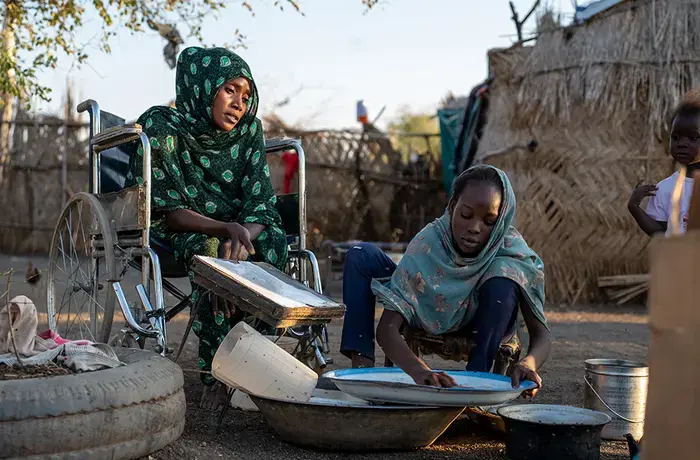
A woman in a wheelchair sits outdoors beside a girl washing dishes, with a child standing nearby.
FAQs

How war impacts women and girls: A simple explainer on gender and conflict

26 October 2026
On 10 December 2024 in Sudan, Omnia [NAME CHANGED] peers through the window during a visit to a women’s organization. Displaced from her home due to fighting and threats, she lives with the trauma of being kidnapped, threatened, beaten and raped by armed men. To support her healing, Omnia is receiving mental health and psychosocial support from a women’s organization. Photo: UNICEF/UNI754435/Tess Ingram
Press release

Sudan's war on women: The number of people in need of sexual violence support quadruples as abuse of women and girls becomes the blueprint of war, three years on

14 April 2026
Image
UN Women team members listen to women at the Alazhri Gathering Site in Port Sudan during a day of emergency assistance distribution. Photo: UN Women/Ekram Hamad Fadlalla.
FAQs

How women and girls are being targeted in the war in Sudan

14 April 2026
Image
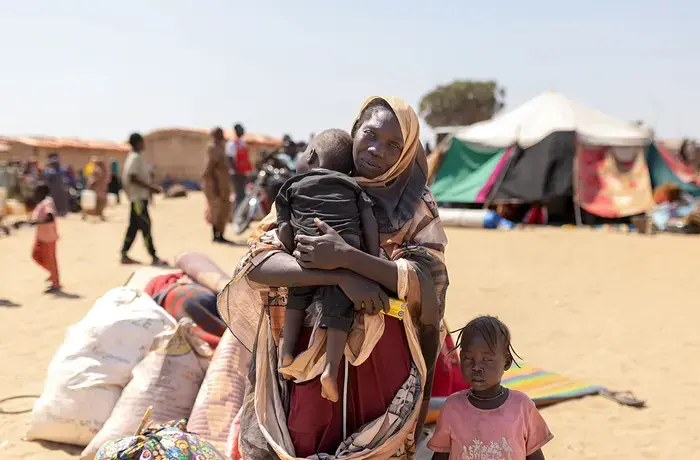
A woman holds a child and looks at the camera, with belongings behind her and another child beside her.
In focus

Sudan war: Inside the world’s worst humanitarian and protection crisis for women and girls

23 October 2026

Topics

  • Ending violence against women and girls
  • Peace and security
  • Conflict, war
  • Sexual violence in conflict
  • Africa
  • Sudan

Related content

Image
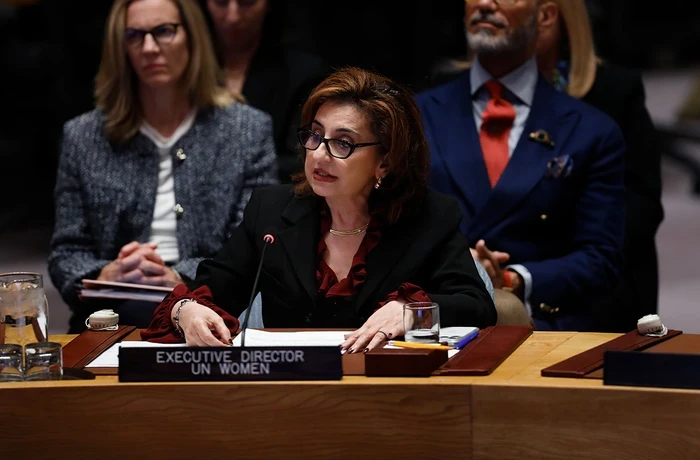
UN Under-Secretary-General and UN Women Executive Director Sima Bahous delivers remarks to the Security Council open debate on women and peace and security, UN headquarters, 27 October 2026. Photo: UN Women/Ryan Brown.
Speech

Speech: Do we have the courage to share power, the resolve to invest in women’s leadership, and the political will to turn our commitments into action?

27 October 2026
Speech: Do we have the courage to share power, the resolve to invest in women’s leadership, and the political will to turn our commitments into action?
Image
UNWomen_Placeholder
Press release

Women and girls’ death toll in armed conflict doubles since 2021

26 October 2026
Women and girls’ death toll in armed conflict doubles since 2021
Image
UNWomen_Placeholder
Press briefing

The UN Secretary General’s report on Women, Peace, and Security

26 October 2026
The UN Secretary General’s report on Women, Peace, and Security

Footer menu-HQ

  • News and stories
  • Resources
  • What we do
  • How we work
  • Where we are
  • Partnerships
  • Employment
  • Procurement
  • Contact us
  • Executive Board
  • Commission on the Status of Women

Donate button menu [Footer tablet]

  • Donate

Donate button menu [Footer]

  • Donate

Social media menu

  • Facebook
  • Twitter
  • LinkedIn
  • Flickr
  • YouTube
  • Instagram
UN Women - For all women and girls

Footer bottom [Menu]

  • Copyright
  • Information security
  • Privacy notice
  • Report wrongdoing
  • Terms of use
Share this page
  • Share to Facebook
  • Share to Twitter
  • Share to LinkedIn
  • Share to E-mail

Or copy link