
Universal menu

  • Global
  • Regions
    • Africa
    • Americas and the Caribbean
    • Arab States
    • Asia and the Pacific
    • Europe and Central Asia
  • Knowledge
  • Data
  • Training
  • Transparency
UN Women - For all women and girls

Main Navigation-HQ

  • Who we are
    • About us
      • About UN Women
      • Business model
      • Guiding documents
      • Worldwide presence
    • Leadership
      • Governance structure
      • Executive leadership
      • Executive Board
      • Accountability
    • Work with us
      • Employment
      • Procurement
      • Calls for proposals
      • Contact us
      • UN Women Strategic Plan 2026–2029
      • UN Women Strategic Plan 2026–2029 - social media image
        UN Women Strategic Plan 2026–2029
  • What we do
    • Focus areas
      • Ending violence against women
      • Peace and security
      • Humanitarian action
      • Leadership and governance
      • Economic empowerment
      • Innovation and technology
      • Women with disabilities
      • Youth
      • HIV and AIDS
    • How we work
      • 2030 Agenda for Sustainable Development
      • Commission on the Status of Women
      • Gender parity in the UN system
      • Intergovernmental support
      • Partnerships
      • Research and data
      • Training Centre
      • Trust funds
      • UN system coordination
      • Gender Equality Accelerators
      • Gender Equality Accelerators artwork
        Gender Equality Accelerators
  • News and stories
    • Latest
      • News
      • Articles and explainers
      • In focus
    • Media center
      • Press materials
      • Media contacts
      • Explainer: Why are women so exhausted? Care work and the mental load
      • Two adults stand at a table changing diapers on baby dolls, with laundry hanging on a clothesline behind them in a home setting.
        Explainer: Why are women so exhausted? Care work and the mental load
      • Press release: Aid cuts dismantle women’s organizations working in humanitarian crises
      • A young Ugandan woman sits with another local woman to talk
        Press release: Aid cuts dismantle women’s organizations working in humanitarian crises
  • Digital library
    • Resources
      • Publications
      • Annual reports
      • Gender snapshot
      • Progress of the world’s women
      • World survey on the role of women in development
    • GenderTerm
      • GenderTerm
      • Reprint permissions
      • UN Women Highlights 2025–2026
      • A smiling woman.
        UN Women Highlights 2025–2026
      • Gender snapshot 2026
      • A diverse group of people represented as simplified silhouettes, arranged against a dark blue background.
        Gender snapshot 2026
  • Get involved
    • How to get involved
      • For ALL Women and Girls
      • International Women's Day
      • 16 Days of Activism to End Violence against Women and Girls
      • UNiTE! Campaign to End Violence against Women
      • Generation Equality
      • He for She
Ask AI
https://84e5cfacd5c7e99f9825edf344450c.1b.environment.api.powerplatform.com/powervirtualagents/botsbyschema/crad4_websiteQA/directline/token?api-version=2022-03-01-preview
1
-
Ask your question here
AI website assistant

Hello, how can I assist you?

AI chatbot responses may be incorrect. Always verify important information.

Donate button menu

Donate

Breadcrumb

  1. Home
  2. News and stories
  3. Feature story

Website survey

We want to know how we can improve your experience on this website. Completing this survey takes less than 5 minutes.

TAKE THE SURVEY
Feature

Pushing forward: Preventing violence against women in online spaces

18 November 2022
  • Share to Facebook
  • Share to Twitter
  • Share to LinkedIn
  • Share to E-mail

Marwa Azelmat is a digital rights expert and an activist involved with women’s rights movements and organizations around the world. At the intersection of these issues, Marwa is facing off against a central barrier to progress on both: online violence against women and girls.

Image
Portrait of Marwa Azelmat. Photo courtsey of Marwa Azelmat
Marwa Azelmat is a digital rights expert and feminist activist. Photo courtsey of Marwa Azelmat

Not just an insult

There’s a tendency, Marwa explains, not to take online violence seriously. “I keep hearing, ‘but this is just an insult,’” she says.  

But it isn’t. Online violence against women is part of a spectrum of gender-based violence that keeps women from exercising their full human rights, both online and off. “What happens in the offline space is really reflected in the online space,” Marwa emphasizes. “And just like […] we don’t feel safe walking on the streets, we no longer feel safe walking on the digital streets.”

When online violence forces women out of digital spaces, the consequences can be far-reaching. Targeted campaigns against women human rights defenders and journalists imperil their work—and, at times, their lives. And women’s exclusion from the digital economy has wider implications for a country’s economic development. “[Online violence against women] should be seen as a threat to the public order,” Marwa says.

The legal system, however, doesn’t see it this way. In the eyes of the law, online attacks against women are standalone incidents. Rather than examining underlying causes and investing in prevention systems, “they just try to fix the incident”, Marwa says. And there usually isn’t much they can do in response to a complaint, anyway, since the onus is on the victim to provide proof—which a tech savvy attacker will likely have deleted.

Today, growing anti-feminist backlash, combined with increased reliance on digital spaces, is heightening online risks for women. “Movements sustain themselves right now [in] online spaces,” Marwa says—giving anti-rights activists new opportunities to infiltrate.

This is a matter of free speech, Marwa emphasizes, and governments have a responsibility to protect against violations: “We can’t undermine [free speech] just because it’s online.”

Power up

It was Marwa’s own experience studying information technology engineering that made her realize the urgency of integrating women’s rights with tech. “I felt like the system was really structurally marginalizing,” she explains. More women in STEM is not enough, Marwa says: “At the end of the day, we have systems that have not been designed to serve women.”

So she went back to school for international human rights law, specializing in information and communications technology (ICT). From there, she started working with women’s rights organizations, helping to bridge the gap between feminist movements and the tech sector.  

Protecting women’s digital rights will require coordinated action from governments and the private sector, Marwa emphasizes. But there’s a part for all of us to play.

When you see violence online, don’t let it slide—report it. Call on tech companies to collaborate more fully with civil society organizations and the government, and make use of available forums—such as requests for public comments often made by oversight boards—to hold them responsible.  

“To counter online violence at the individual level is to start by not accepting impunity,” Marwa says. 

New connections

In a future without online violence, Marwa sees an online world full of women and girls getting to meaningfully connect. “Right now we have two billion women that are disconnected [from the internet],” Marwa says. “And that’s huge.”

But it’s more than a question of numbers. She imagines a new online world altogether, one not dominated by the interests of a few wealthy men: “an alternative feminist internet that works for everyone—not just women, but also gender diverse people and [other] marginalized communities”. That, she says, is the future we should be fighting for.

Topics

  • Ending violence against women and girls
  • Information and communications technology (ICT)
  • Ending impunity
  • Arab States/North Africa
  • Morocco

Related content

Image
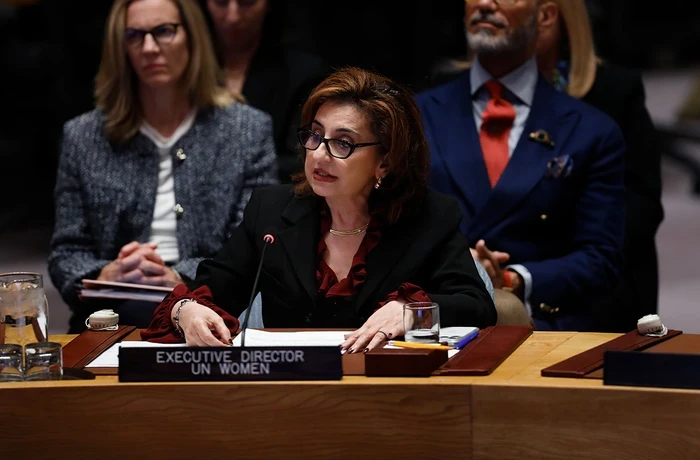
UN Under-Secretary-General and UN Women Executive Director Sima Bahous delivers remarks to the Security Council open debate on women and peace and security, UN headquarters, 27 October 2026. Photo: UN Women/Ryan Brown.
Speech

Speech: Do we have the courage to share power, the resolve to invest in women’s leadership, and the political will to turn our commitments into action?

27 October 2026
Speech: Do we have the courage to share power, the resolve to invest in women’s leadership, and the political will to turn our commitments into action?
Image
UNWomen_Placeholder
Press release

Women and girls’ death toll in armed conflict doubles since 2021

26 October 2026
Women and girls’ death toll in armed conflict doubles since 2021
Image
UNWomen_Placeholder
Press briefing

Nine in 10 organizations say trauma persists among women and girls displaced from El Fasher a year after its fall

23 October 2026
Nine in 10 organizations say trauma persists among women and girls displaced from El Fasher a year after its fall

Footer menu-HQ

  • News and stories
  • Resources
  • What we do
  • How we work
  • Where we are
  • Partnerships
  • Employment
  • Procurement
  • Contact us
  • Executive Board
  • Commission on the Status of Women

Donate button menu [Footer tablet]

  • Donate

Donate button menu [Footer]

  • Donate

Social media menu

  • Facebook
  • Twitter
  • LinkedIn
  • Flickr
  • YouTube
  • Instagram
UN Women - For all women and girls

Footer bottom [Menu]

  • Copyright
  • Information security
  • Privacy notice
  • Report wrongdoing
  • Terms of use
Share this page
  • Share to Facebook
  • Share to Twitter
  • Share to LinkedIn
  • Share to E-mail

Or copy link