
New global directory offers a lifeline of support for women and girls who experience violence
Launching this month, the Lila.help website directory lists accurate, vetted and safe helplines and local emergency service information for more than 90 countries, and aims to expand to every country and territory. The website was developed by the Global Network of Women's Shelters (GNWS) with financial and technical support from Australia’s Department of Foreign Affairs and Trade (DFAT) and UN Women.
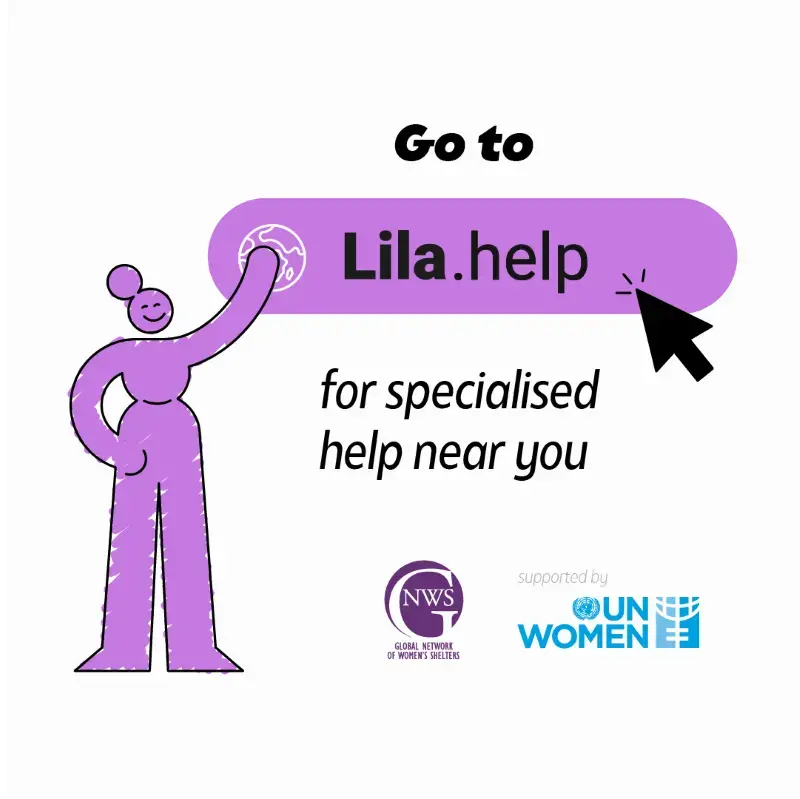
"In this digital age, I can find almost anything online anywhere in the world, but if I am abused or sexually assaulted, it is incredibly hard to find reliable, local information about where I can turn to for help," says Cindy Southworth, a founding member and a current advisor at the GNWS. "For years, there was practically no functioning global directory, so we developed one, and called it Lila.help."
Lila.help is easily accessible for everyone – a survivor, family or friends, service providers, embassy or tourism staff or anyone looking to find support.
"Lila.help includes national helplines, and local NGO shelters and crisis centres because local advocates often know specific community details best. For example, a favourite detective who treats survivors with respect or a judge that only grants protection orders on specific days of the week in a small town. Having direct access to both national helplines and local NGOs allows women to make an informed decision about where to go for particular services they need quickly," explains Southworth.
A global essential service
Since 20209, GNWS and UN Women have used their global networks to identify qualified and respected national helplines, local shelters, and crisis centres for women experiencing, or at risk of experiencing, violence worldwide.
“Over 60 of our offices have provided information on support services for this directory. Real time support for survivors is critical, especially given the near global increase in the number of women calling helplines and reporting abuse during the COVID-19 crisis,” says Kalliope Mingeirou, Chief of the Ending Violence against Women Section at UN Women. .
One of the challenges in the past for many websites with regional or global coverage is that information provided has often been inaccurate, outdated or is not specific enough. Lila.help includes features to solve these challenges, such as allowing service providers to enter their own information, including languages offered, accessibility information on the centre and children’s services. Lila.help also requests frequent updates from service providers to ensure accuracy.
"They can also use their own words to describe culturally-specific services designed to meet the complex needs of women in all their diversity, such as documented or undocumented migrant women, sex workers and LGBTQIA+ people," explains Southworth.
All partners listed on the website are run by feminist organizations, provide quality survivor-centred services and do no harm to survivors.
Lila.help users can contact helplines, shelters and crisis centres via chat, text or email (where possible), in addition to directly calling on the phone, allowing users to reach support without fear of having their conversation overheard. An exit button automatically switches to another webpage to protect women from further harm if an abuser is nearby.
Women leading the way
Information collected through Lila.help will provide an evidence base to demand accountability from governments for the universal provision of quality emergency services. At the same time, GNWS fosters a global community of NGO shelters that provide emergency services when government support is lacking.
"In Latin America many countries are withdrawing state funds, making it difficult to operate women's emergency services. In this environment, we see services provided by NGOs as the most reliable way to ensure women have access to immediate help," explains Margarita Guille, Coordinator of the Inter-American Network of Women Shelters, a regional partner of the GNWS. "Through a regional community of shelters, we are supporting each other to grow together."
In 2020, the COVID-19 pandemic hit countries in Latin America hard, many of which already had high rates of violence against women and femicide. "Many NGOs had lost funds to operate emergency services just as the demand grew drastically. Many NGO leaders had also lost their families and friends from the of increased violence against women and COVID-19. They were worried about how to continue to provide services to women during this new health crisis," says Guille.
As part of the multi-year EU-UN Spotlight Initiative to Eliminate Violence against Women and Girls, UN Women supported the Inter-American Network of Women Shelters to offer mentoring programs for women leaders of shelters from 18 countries. At the end of the program, 98 per cent of shelter leaders reported feeling confident in their personal ability to seek resources to continue providing emergency services during the COVID-19 pandemic, compared to 10 per cent at the beginning of the program.
"It is critical to invest in women leaders and service providers because they can influence the entire team to provide quality emergency care," says Guille. "Violence impacts many women around the world. But if women can quickly find information on where to seek help and receive specialized care from trustworthy service providers that can be a game-changer to minimize the consequences of violence."
