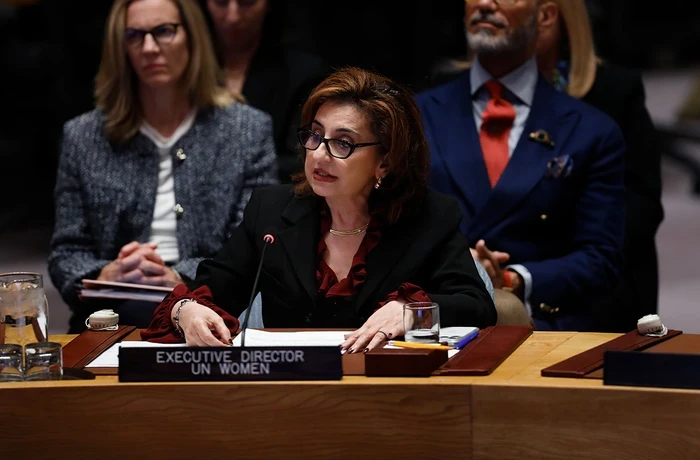
Speech: Game-changing rewards: Women as empowered agents of stability, accountability, and peace
Remarks by UN Women Executive Director Sima Bahous at the briefing of the UN Security Council on the situation in the Great Lakes region, on 15 April 2026, at the UN Headquarters.
[As delivered.]
The opportunities of women’s leadership for peace in the Great Lakes region are unique and transformative, and give us hope.
I remind us that this Security Council’s first resolution on women, peace and security in the year 2000, was in part inspired by Nelson Mandela’s support to Burundian women to play their rightful part in ending the civil war in their country. Their proposals, ideas and energies suffused the Arusha accords. War ended. Burundi today boasts one of the highest percentages of women’s representation in politics in its region, alongside thousands of women mediators working at local level, preventing small conflicts from becoming bigger ones.

UN Women is proud to support such efforts. In the Karamoja region of Uganda, for example, women lead cross-border dialogues to prevent conflict and build peace. In Uganda also, women’s representation in certain district and sub-county peace committees has nearly tripled, from 17 per cent in 2022 to 46 per cent in 2025. Twenty-one districts now have local action plans on women, peace and security, 16 of which were supported directly by UN Women.
Peace in this region, as we have heard, hinges on the Eastern region of the DRC [Democratic Republic of the Congo], and peace in the DRC will only be secured when women are treated not as collateral victims and their bodies as spoils of war, but as empowered agents of stability, accountability, and peace. Without safety, women cannot lead, and without their leadership, peace and recovery efforts fail. The same applies across the broader region.
The Great Lakes region offers fertile ground for women’s leadership in peace and security, with some of the highest percentages of women’s representation in politics in the world: 11 of 12 countries of the International Conference on the Great Lakes Region have national action plans on women, peace and security.
The new regional action plan (2026–2030) focuses on integrating women into peacebuilding, and addressing gender-based violence, including in digital spaces. The regional gender barometer monitors gender equality efforts in the region.
And there is the Advisory Board for Women, Peace and Security in the Great Lakes Region. I thank the Special Envoy for his collaboration and efforts to turn this platform into a mechanism that can link the efforts of women at the grassroots level with high-level diplomacy.
The soon-to-be adopted African Union Commission framework will enforce a minimum 30 per cent women’s representation in AU-led mediation, based on the mandate outlined by the African Union’s Peace and Security Council. UN Women applauds this ground-breaking initiative and calls on other multilateral bodies to follow their lead.
Specifically in DRC, despite the conflict, we see a positive trajectory for women’s representation in politics, including senior leadership. And we see where that can lead: it can lead to greater accountability for gender-based violence and crimes, with hundreds of members of rebel groups and the DRC’s own armed forces put on trial for sexual violence, ensuring that women, albeit still in small numbers, receive the justice they deserve.
The space is there. The potential rewards are game-changing. So, I have three asks of you today:
First, I ask that you lend your voice ever more to calls for equal representation of women in peacemaking efforts in the DRC and the broader region. More women in parliament or cabinets is positive but does not guarantee meaningful representation in peace and security decision-making. While two of the five facilitators of the AU-led process are now women, the Washington Accords are silent on women, gender-related issues, and even the sexual violence that has been both hallmark and driver of conflict. UN Women has supported Congolese women’s advocacy, but without this Security Council’s support, they will remain on the outside, looking in.
Second, I ask that you protect the peacekeeping mission, MONUSCO, and its critical mandate in the DRC. And recall the hundreds of trials against perpetrators of conflict-related violence. Recall the women activists and human rights defenders who have enjoyed MONUSCO’s protection. Recall the women supported in their crucial work in local peace efforts between the Hema and the Lendu in Ituri. Recall also that peacekeepers tailor their patrols to specific alerts received from local women, that they have opened their bases to protect displaced women at imminent risk.
Now consider what removing this means. Consider the 60 per cent of women human rights defenders in North Kivu reporting ongoing direct threats. Consider Medicines Sans Frontières’s reports of 28,000 victims of sexual and gender-based violence in the first half of last year. And consider that currently the mission has no senior women’s protection advisor, and a weakened gender unit. MONUSCO—but more importantly those civilian women and girls, men and boys that it serves—deserves much better.
Third, I ask you to support women-led civil society organizations and protect civic space. Women’s organizations are crucial but unappreciated front-line peacebuilding actors. They also represent critical defense against democratic erosion, which can lead to more conflict. In this region as much as any, despite high percentages of women in politics, perhaps even, in part, in pushback to it, we see precisely that democratic erosion, narrowing space for civil society and human rights. Despite this, we are far from meeting the needs. We could empower thousands of women peace actors across the Great Lakes at a fraction of the cost of military spending for vastly better results. The Security Council could make the difference to unlocking the necessary support and offering protection in and of itself.
Let me just add that my asks are neither impractical nor beyond what this august Council can do. We owe the women of the Great Lakes region—those determined, inspiring women who work tirelessly today for peace tomorrow—we owe them our best. The opportunity is there, the path to seizing it is clear.
I urge us all to walk that path together, now. And to commit to gender equality and women’s leadership, so that this region can finally find peace.
I thank you, Mr. President.