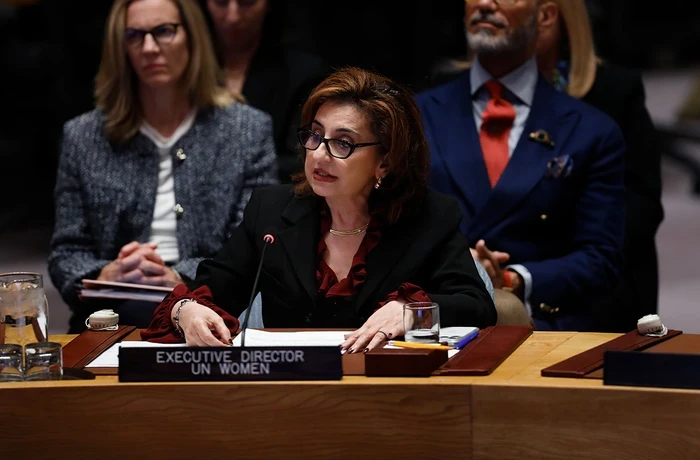
Women’s voices rising without fear: our goal and challenge for peace and security
Briefing delivered by UN Women Executive Director Sima Bahous at the open debate of the UN Security Council on Women, Peace and Security, on 24 October 2024.
[As delivered.]
Today, we commemorate the United Nations Day. We are reminded of the UN's noble mission to promote peace, human rights and development for all. We are reminded of the continued need for diplomacy, dialogue and negotiation to prevent and resolve conflicts - and to ensure dignity, equality, and justice for all women and men. I am honoured to join you on this UN day, in this Annual Open Debate on Women and Peace and Security.

During the high-level week of the recent General Assembly, a Nigerian poet speaking at an event on dismantling patriarchy asked: “What is peace if not a world where power is shared, where voices rise without fear?”.
The idea of voices rising without fear crystalizes both our goal and our challenge.
We recall the fear of millions of Afghan women and girls robbed of an education, a future, and a voice, how they suffocate in silence - prisoners in their own homes.
We recall the fear of the women in Gaza, displaced many times over, waiting for death, whether by bombs, fire, disease, or starvation. How they know neither what to feed their children or how to feed them, what to tell them of their futures after a year of relentless destruction with no end in sight.
We recall the hostages held in Gaza and their anxious families and mothers who are still waiting for their release.
And we recall the fear of women and families in Lebanon as their towns are under bombardment.
We recall the fear of the women in Sudan, displaced, victims again of sexual violence perpetrated by men with guns, seeing history repeat itself, with no place to turn for food, water, or safety.
We recall the fear of women in Haiti, who continue to endure senseless violence, displacement, and insecurity.
We recall the fear of the women in Myanmar, detained by the thousands for raising their voices against a coup. How they wait with shrinking hope in refugee camps across the border. How for some that hope is extinguished after seven long years of exile.
We recall the fear that sits on the shoulders and lives in the hearts of our sisters in Congo, the Middle East, the Sahel, South Sudan, Syria, Ukraine, Yemen and the list continues.
The fears of 612 million women and girls now affected by war, 50 per cent more than a decade ago.
They, like many others, wonder if the world has already forgotten them, if they have fallen from the agenda of an international community overwhelmed by crises of ever-deeper frequency, severity and urgency.
What greater responsibility do we collectively hold than to answer those fears with hope?
As you have read in the Secretary-General´s report, in 2023, the proportion of women killed in conflict doubled. The number of verified cases of conflict-related sexual violence increased by 50 per cent, and the number of girls affected by grave violations grew by 35 per cent.
One in two women and girls in conflict-affected settings are facing moderate to severe food insecurity.
Sixty-one per cent of all maternal mortality is concentrated in 35 conflict-affected countries. With maternity wards bombed, blocked reproductive healthcare, and rising sexual violence, these numbers will continue to rise.
The Secretary-General’s report reminds us that all this takes place against a backdrop of inadequate attention to women and their leadership and voice in our efforts for peace. Women’s participation in decision-making and politics in conflict-affected countries is stalled.
The percentage of women in peace negotiations has not improved over the last decade: under 10 per cent on average in all processes, and under 20 per cent in processes led or supported by the United Nations. In 2023, we had fewer peace agreements and fewer Security Council resolutions with gender-related provisions.
All this as military spending increased dramatically, as gender equality spending dipped, as funding for women’s organizations in conflict-affected settings fell for the third year in a row, and as only 23 per cent of total funding requirements for gender-based violence prevention and response in humanitarian response were met.
The current pushback against the very idea of gender equality and women’s empowerment is real and is seen in too many spaces.
It plays out no less in conflict-affected countries, but there the consequences are even more lethal.
Women’s rights to move, to be heard, to earn a livelihood, to denounce abuse, and to make choices for themselves and their bodies can represent the difference between life and death. The weaponization of misogyny for political gain is extracting a price we will pay for generations.
That price will be more conflicts, longer conflicts, more devastating conflicts. We as the international community can and must work collectively to prevent this.
That is why it is incumbent upon us to match the bravery, in many cases unbelievable and sometimes even unreasonable, of the women I meet around the world.
They do what sometimes seems beyond us. They broker agreements for humanitarian access in crisis. They end tribal conflicts. They disarm and deradicalize young men in their communities. And they do this denied the funding and support that they deserve because we, do not always afford it to them.
In Syria, we have documented stories of women who were homemakers but when called upon stepped up to play a decisive role in ending the siege in several districts because their male relatives were at a higher risk of being arrested or killed.
In Afghanistan, women have stepped up by opening schools in their homes.
In Ukraine, women coordinate the delivery of humanitarian aid in areas where basic infrastructure has collapsed and support the safe evacuation of civilians in need.
In the Democratic Republic of the Congo, thanks to the bravery of women witnesses and survivors, the crime of forced pregnancy was successfully tried by a national court, for the first time ever globally.
It resulted in a historic conviction and sentence to life imprisonment for crimes against humanity of a former militia leader in 2023.
Every victory we celebrate has at its root women on the ground stepping up. Always.
Women are frustrated by the meetings they are invited to in the margins of actual decision-making, the many consultations which many times have no outcome, the strategies that don’t have funding. They want to see the Women, Peace and Security agenda implemented and resourced.
They have called on us to commemorate the 25th anniversary of 1325 next year with action. By pursuing accountability for gross violations of women’s rights. By removing discriminatory laws. By making policy commitments with a target and a deadline, whether for women in peace negotiations, or funding for gender equality, or for women’s organizations in the frontlines of conflict.
The Secretary-General’s report is a rich source of these minimum targets and of important recommendations.
Earlier this month, as a direct result of advocacy and Member States joining forces, the European Court of Justice, the ECJ, ruled that gender and nationality alone are sufficient for a country to grant asylum in the EU to Afghan women based on the documented gender persecution in Afghanistan.
These are sparks of progress we hope will ultimately become flames.
Next October, marks 25 years since Namibia tabled Security Council Resolution 1325 in this very Chamber, and its unanimous adoption. The last five years have not seen much progress, rather regression on the agenda.
So, if our commemorations are to have any real value, they must be founded on a demonstrated commitment to do things differently and better.
We have a solid foundation on which to build. 110 Member States have adopted national action plans on women, peace and security, up from 19 in 2010.
Our commitments to women, peace and security have been reinforced and reiterated by every recent multilateral agreement.
Support for women’s full, equal, and meaningful participation has become one of the most common phrases in Security Council resolutions. What remains is for us to make those a reality in practice, not least through our funding decisions.
This is how we give women peacebuilders a fighting chance. It is how we make peace more possible and durable, how we prevent new conflicts and recover faster from those already upon us.
This is how we accelerate our drive towards realizing the 2030 Agenda and SDG5. This is how we recommit to the Beijing Declaration and Platform of Action at 30 next year.
This is how we make a reality of our commitments and commemorate the anniversary of 1325 in the way the world’s women and girls would have us commemorate it. How the world needs us to commemorate it. UN Women stands alongside you all to make that our shared reality.
I thank you.