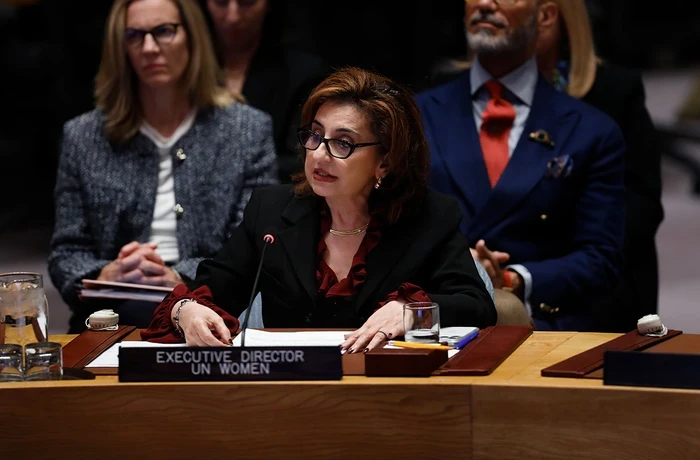
Speech: We must step forward – the situation is not hopeless, and we are not helpless
Speech delivered by UN Women Executive Director Sima Bahous to the UN Security Council meeting on Afghanistan, on 18 September 2024, at UN Headquarters.
[As delivered.]
I am grateful for the opportunity to brief the Council today. My thanks also to Slovenia for focusing this debate on women and girls. We have heard and will continue to hear today about the Taliban’s new morality law, made public this August 21st by the de facto Ministry for the Propagation of Virtue and Prevention of Vice. While much of the law was already in place in prior decrees or edicts of the de facto authorities, this law introduces a new low where we thought there was nowhere lower to go.
It requires women and girls to cover their entire bodies and faces everywhere outside their homes. It forbids them speaking in public, using public transportation alone, or even looking at men to whom they are not related by blood or marriage.
As you know, this comes on top of edicts issued over the past three years segregating women and men in daily life, prohibiting women from using gyms, parks, or public baths and more.

What makes this even worse is that because many of the provisions are ambiguously worded, we already see that they are in practice subject to arbitrary interpretation, thereby granting extensive powers of enforcement to the morality police. Thus, Afghanistan’s women do not only fear these oppressive laws, they also fear their capricious application. A life lived in such circumstances is truly incomprehensible.
The new morality law does not only segregate women from men. It isolates them from other women too. In our surveys, only 22 per cent of Afghan women report meeting with women outside their immediate family on a daily or weekly basis, while 18 per cent never do.
Not surprisingly, 90 per cent of Afghan women and girls report that their mental health is bad or very bad, with a majority of women reporting that their mental health is getting worse every quarter, and 8 per cent knowing at least one woman or girl who has attempted suicide.
In our surveys, 64 per cent of women felt completely unsafe leaving their house by themselves, a percentage that has increased in recent months and will likely increase with the new law. When asked why they felt unsafe, 70 per cent attributed it to harassment by the de facto authorities. Place all this alongside “honour” killings, corporal punishments, domestic violence, and rising maternal mortality.
We cannot forget that it is not only women who suffer in this environment. Our data shows that men feel less safe when they have to accompany women. Many men are also becoming de facto enforcers, souring relationships with their neighbours, and destroying social trust and cohesion.
And while millions of Afghan women and girls are prevented from attending school, millions of Afghan boys are in school receiving only the education that is sanctioned by the de facto authorities, and we do not know what the curriculum entails.
At least before the promulgation of this new morality law, and in spite of enormous risks, women continued to run businesses, work in organizations for the improvement of their communities, or protest against injustice. In 2021, 88 per cent of these protests were held outdoors. By 2022, fewer than half were.
Currently, 94 per cent of protests are held online, hiding their location and identities. And this new “morality law” has also triggered a new wave of protests online, where Afghan women are seen singing, with their faces uncovered and their hair loose, in a show of defiance against the law.
These bans continue to destroy Afghanistan’s overall economic prospects too. It is projected that the Afghan economy will lose 5 per cent of GDP annually by excluding women from the workforce, and the equivalent of two-thirds of today’s gross domestic product by 2066 if the suspension of women’s access to higher education remains in place.
Our projections estimate that maternal mortality may increase by 50 per cent by 2026 because of this ban. That translates to thousands of additional deaths of Afghan women during birth every year for preventable causes and policy choices.
I do not need to point out to this Council the potential implications beyond Afghanistan’s borders. We are seeing developments in Afghanistan inspiring other oppressive actors elsewhere. We are in the midst of a global backlash against gender equality gains and the weaponization of misogyny.
How the international community rises to the unacceptable extremes of Afghanistan is not just a test of who we are. It is being watched carefully by political actors and armed groups in other countries and regions.
I assure you, if we give up on Afghan women, if we succumb to fatalism, let go of our principles, turn our faces, and remove our resources, the impact on our broader struggle for gender equality may be felt for decades.
Women’s absence from key decisions, discussions, and agreements—from Bonn, to Doha, to Sochi, and more—contribute to the ongoing cycle of exclusion. As UN Women, we implore the Security Council and key international actors to learn from past experience and the failures that excluding women bring. We must not trade away women’s rights or women’s representation in the pursuit of some possible and incremental progress whether on counter-narcotics or terrorism prevention. This approach failed us in the 1990s. It will fail us again.
So instead of turning away, we all must step forward in three ways.
First, invest in and strengthen women-led civil society organizations, including through long-term, flexible funding. In Afghanistan this requires changes to the usual mechanisms and risk management, but as realities and needs change, so must our ability to support.
Second, commit that at least 30 per cent of all funding for Afghanistan be to initiatives that directly target gender equality and women’s rights. No more gender-blind interventions. No more weak or superficial mainstreaming of gender into other initiatives. This does not work in Afghanistan. Afghan women continue to demonstrate remarkable resilience and leadership by establishing new civil society organizations to serve their needs and the needs of others. They are also creating and running businesses that not only provide for their families but that serve and sometimes uplift their communities. We must support these efforts.
Third, stop normalizing discriminatory practices. Stop sending all-male delegations to meet with the Taliban, or having women present only in administrative functions. Commit to gender parity in international interactions with the de facto authorities.
Ensure that all decision-making fora concerning the future of Afghanistan address women’s rights as part of the agenda and include the meaningful participation of women, whether through quotas for each delegation or a women’s delegation.
Afghan women have told us consistently that they want the international community to facilitate their direct talks with the de facto authorities. They are telling us we are failing them, and this must change.
We do not claim that these actions and others will change Afghanistan overnight, nor bring girls back to school right away, but they are achievable, and they will plant the seeds of change in the future. That is what we can do now, today; and our action or inaction in these extremely feasible and practical ways are what we will be judged by, not only by the women and girls of Afghanistan, but by the world.
It is eminently understandable that, to many, the situation of Afghanistan’s women and girls may appear intractable and hopeless. I tell you that it is not. It is not hopeless, and we are not helpless. We can decide now to put our political will and resources behind our solidarity with Afghan women. We can decide now to fund women’s organizations, women’s businesses, women’s leadership, services for women.
We can decide now to create spaces in every policy forum available for Afghan women to be heard-from directly.
In conclusion, we can act, we can redouble our resolve, we can maintain our relentless progress down a path that is hard and long but is there. I implore you again not only to stay this course, but to commit to it with renewed determination. We stand alongside you and all partners as we do this together.
I thank you.