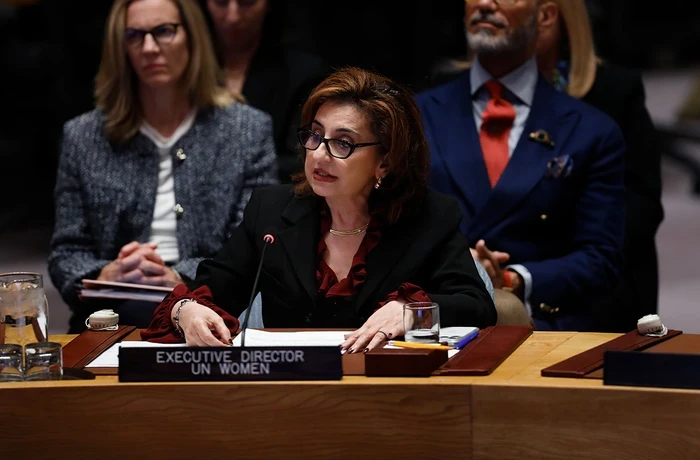
Speech: Seize opportunities, rise beyond challenges, recommit and push forward, boldly
Remarks by UN Women Executive Director Sima Bahous to the Security Council’s debate “Maintenance of international peace and security: the role of women and young people”.
[As delivered.]
My thanks to Mozambique for convening us around the crucial agenda of women, youth, peace, and security.
On November 1st last year, UN Women published a story about a 34-year-old psychotherapist in Rafah. She specialized in helping patients process the trauma of living in conflict. Her name was Amani.
A few short weeks ago, on May 7th, Amani was killed alongside her four children.
Amani is one of more than 10,000 women killed in the last seven months. Just yesterday, scores of women and children were horrifically killed in Rafah, in a safe zone while they were asleep in tents in a camp for the displaced. It is for Amani, and for them, and for all women and girls caught in this conflict, that we demand a permanent ceasefire, unhindered humanitarian access, the release of all hostages, the determined pursuit of peace and a two-state solution. This war must stop, because women and girls are bearing the brunt of it.
Last year, nearly 300 human rights defenders were killed, 49 of whom were women. These are just the known cases, there are likely many more.
In January 2023, Mursal, a young woman, and former member of Parliament in Afghanistan, was shot and killed in her home near Kabul. She stayed behind when the Taliban took over, still clinging to hope that her contribution to the development of her country would be valued.
In October last year, Halima, a 30-year-old journalist was killed while covering the war in her native Sudan.
Amani, Mursal, Halima and the lives of women whose names we will never know, were a demonstration of the power of women’s contribution in crisis. The way they carry their families and nations on their shoulders and the way they bear the brunt of it all. The imperative of their knowledge of their communities, their voice and leadership in decision-making.
Their death is another painful reminder of the realities of war for women and girls, and that the disproportionate harm inflicted on women during wars and conflicts not of their making.
To echo the Secretary-General, “to silence the guns, we must raise the voices for peace.”
While here we rightly embrace Security Council Resolution 1325 as a crucial global norm, for them it remains a distant dream. Not only in Gaza but in Haiti, in Myanmar, in Sudan, in the DRC, in Yemen, in Afghanistan, in too many countries to count the world over.
I salute this Council´s efforts on increasing the voices of women, including young women, as briefers. I commend this and urge you to continue to do so, to listen, to engage, and to act on their asks.
Young women and girls face a double discrimination that is intensified during conflict: discrimination for their sex, and for their age.
I applaud the examples of progress made to address this in the Secretary-General’s report on youth, peace and security, which USG DiCarlo shared with us. Allow me to share a few more examples, highlighting what can be done.
As UN Women we have conducted capacity-building initiatives for youth organizations to participate in peace processes in Georgia and transitional justice initiatives in Lebanon.
Last year, UN Women and UNFPA supported 79 peacebuilding processes that were inclusive of young women, across 17 different countries.
And since 2016, the Women’s Peace and Humanitarian Fund for which we serve as Secretariat has supported organizations focused on youth or led by young women from 18 different countries. The funding window for women human rights defenders, set up in 2022, has already supported young women from 21 conflict-affected countries.
In Afghanistan, UN Women, IOM, and UNAMA have been conducting quarterly surveys to hear from Afghan women including special emphasis on young women.
We also continue to help break down barriers to inclusion, by finding ways to engage women and young women. For example, we know that inter-generational dialogues in conflict-affected countries can have a powerful impact in communities searching for a way out of violence and division.
We must create more such spaces and ensure representation of women and young women across decision-making bodies.
These examples show us what can be done, and that there are solutions we can take to scale. The reality is that we are not doing so.
This is despite the clear experience that engaging young women in development, in ensuring that they have equal opportunities, including equal access to the job market, helps sow social cohesion and stability, and grows economies.
What we must do is to ensure that we are breaking down power structures and harmful norms that hinder young women and girls from their full and meaningful participation, and that diminish their voice and their crucial contribution as leaders in their own right. And, crucially, we must protect women’s and girls’ education, their autonomy, and their freedom to decide on all their choices in life.
In Afghanistan, it has been three years since the ban on the right to education has left 1.1 million Afghan girls out of school.
In West and Central Africa more than 13,000 schools have closed in recent years because of conflict and insecurity, affecting millions of girls.
In Gaza, girls and boys have been out of school since October 7th.
In Haiti, hundreds of schools have been closed, teachers have been attacked, and thousands of children are out of school.
In Sudan, 19 million school-age children are out of the classroom.
In Ukraine, around 40 per cent of children cannot access continuous education due to a lack of facilities.
There is no second chance at childhood. How can our ambitions, to rise to the responsibilities we have to afford young women and girls the best we can offer, ever be realized when they have been denied their most basic of rights?
I will conclude with three priority areas that require our collective attention, efforts and commitment.
First, we must bring young women to the heart of actual decision-making. When we speak of women’s meaningful participation, including young women, lip service is to be condemned.
Real commitment is quotas, temporary special measures or other concrete, genuine efforts to not only talk about it, but to do it.
Second, we must combat division, hate, and disinformation. Our battleground is increasingly online, and we are losing. I have no doubt that we can ultimately not only win, but that we will win. But for us to win, it will be key, as we find our approaches to the challenges of social media, artificial intelligence, and even to new technologies not yet imagined, that the role of young women in their use, understanding, and regulation will be crucial.
No technology is inherently good or bad until we humans decide how it is to be employed, and how its benefits and harms are to be leveraged.
Third, young women must be far better represented at the peace table and in parliaments. Globally less than 1 per cent of parliamentarians are young women.
Even where opportunities for civic engagement have been closed, you will find them in the streets, joining and leading social movements and protests. Their voices are powerful.
We have seen young women fight and sacrifice for peace, democracy, and gender equality in many conflict-affected countries, from Gaza, to Sudan, to Haiti to Myanmar, to Afghanistan and many more.
They are heroes, they are unrelenting, and they will persist and endure. Of that we should be in no doubt.
The question for us is whether we will stand by their side or instead, as too often, we will lack that courage.
Most of all we must listen and commit not to awaiting a future fit for them, but rather to hastening this future in everything we do. For the distinguished UN Security Council, it must begin with every peacebuilding process supported by the UN in any capacity.
This year brings unique opportunities to place young women at the core of gender equality action.
That includes the Summit of the Future. Next year, the Beijing Platform for Action marks 30 years and UN Security Council Resolution 1325 marks 25 years.
It will also be ten years since the adoption of UN Security Council Resolution 2250, which recognized for the first time the important role and leadership of young people in building and sustaining peace. If you recall, the adoption then was chaired by the Crown Prince of Jordan – the youngest person ever to chair the Security Council.
We must seize these opportunities, rise beyond the challenges which hold us back in the United Nations and elsewhere, recommit and push forward, boldly.
Young women are the leaders of tomorrow and the change-makers of today. We must engage with them as such, with the commitment and urgency they deserve.
And, in this complex landscape of conflicts, crises, and challenges, we must recognize their aspirations everywhere -- as universal.
They have a right to a world free from violence and fear, a world where their dreams can flourish, where they can ascend to their full potential. And protecting and promoting their rights is our duty.
So, let us hold dear the vision of a future where every girl becomes all she can be, where her hopes for a peaceful and vibrant future are our North Star, where we finally act upon our shared responsibility with determination and sincerity. And in that way, let us build, together, the world that our children and their children deserve, the world they imagine and that we need, for all young people, everywhere, always.
I thank you.