Speech: Pushing boundaries, together with our partners
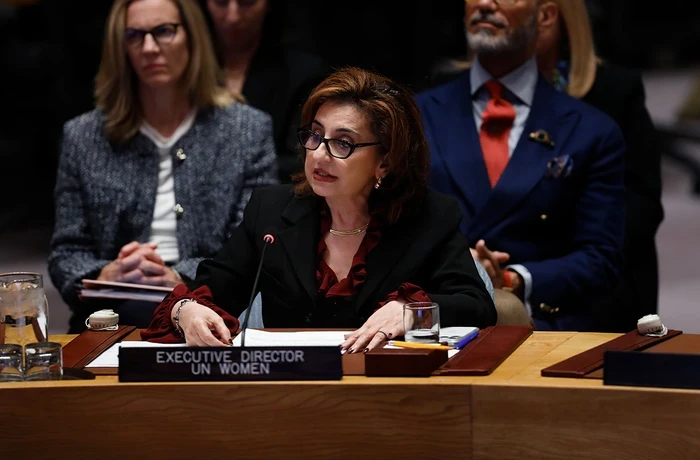
Opening remarks by UN Women Executive Director Sima Bahous to the UN Women Executive Board, at the 2022 annual session.
[As delivered.]
It is a pleasure to join you in my first annual session of the UN Women Executive Board. I am particularly delighted that we can all be here together in person.
I thank our President, H.E. Ambassador Fatima Rabab. This is her last official session before taking up her new role as High Representative for the Least Developed Countries, Landlocked Developing Countries and Small Island Developing States. I congratulate you, Madam President, and look forward to working with you in your new capacity. I know that we have in you a powerful ally for gender equality in the United Nations system.
I also thank all the distinguished Bureau Members, Ambassador Squeff from Argentina, Ambassador Kyslytsya from Ukraine, Ambassador Valtýsson from Iceland, and Ambassador Turay from the Republic of Sierra Leone and all your teams, for your collaboration, guidance, and partnership. I also thank all my colleagues and senior leadership who are with me here today at this Board.

In this first year of our Strategic Plan 2022–2025, and of my tenure, we face unprecedented challenges. The combined crises of conflict, climate, and COVID-19 are pervasive and jeopardize the achievement of the Sustainable Development Goal (SDGs) and Agenda 2030. Last month, the number of displaced people worldwide reached 100 million. Food shortages threaten livelihoods, lives, and political stability. We are facing a global cost-of-living crisis, with food prices almost 21 per cent higher than last year, energy prices surging, and fertilizer rates doubling. This impacts hardest those already left behind, in particular women and girls, and threatens all progress on sustainable development.
We also see a rollback on rights in non-crisis settings. There is a deeply worrying trend of regression on gender roles. Stereotypes are increasing and a woman’s right to make choices and decisions about her own life is shrinking in almost every part of the world.
COVID-19 continues to roll back gains in women’s economic empowerment and fuel violence against women and girls. The war in Ukraine brings unnecessary and excessive suffering to civilians. Those displaced are largely women and girls. They face risks of human trafficking and sexual and gender-based violence.
At the same time, women’s organizations remain at the frontlines, serving the populations who remain behind and those in host communities in neighbouring countries. We must support these women leaders and support them as much as we can.
In Afghanistan, we have watched in horror as women’s rights have been rolled back and assurances made by the de facto authorities have been broken. Women are being silenced, disappearing from public space, and unable to go to school, to work, or to participate in decision-making. We must hold the de facto authorities accountable to promises made to women and girls. All of our engagement in Afghanistan must be driven by our ask for women’s rights.
All these crises hit women and girls the hardest. The majority of those who have lost their jobs in COVID are women. Climate-related disasters disproportionately impact women and girls.
The Sustainable Development Goals are slipping away from us. We must together work to rescue them and get them back on track for 2030. None of the SDGs is on target today.
The latest global assessment of SDG5 shows that only one of its indicators is close to target, which is the proportion of seats held by women in local government. This we must celebrate, but we must keep moving forward.
Our responses to today’s challenges must be judged first and foremost by the extent to which they serve the needs of women and girls globally—and by that judgement, we are all failing.
Women and girls represent one of the most powerful solutions to crisis prevention and sustainable development. We know that women’s involvement in peace agreements leads to better, more enduring settlements, and I continue to call for women’s leadership in talks and in mediation efforts in Ukraine, in DRC, in Ethiopia, in Myanmar, in the Sahel, in Syria, in Libya, and elsewhere.
Anyone who doubts the power of women’s leadership can look to the performance of countries led by women in handling the COVID-19 response.
Inclusive leadership across all levels is the key to unlocking development challenges.
This is why our partnership with civil society and women´s organizations is so critical. Their voices are what raise the alarm. They are on the front lines as first responders. UN Women will continue with civil society, to engage with them and, as outlined in “Our common agenda”, find ways of ensuring that they are heard in multilateral spaces.
UN Women will help ensure that “Our common agenda” delivers to its full potential for women and girls.
We must also continue to harness the transformational power of young people and ensure a whole-of-society approach in addressing harmful gender norms. Men and boys, as outlined in our Strategic Plan, play an important role, and we will continue to engage them to ensure that we are able to enact lasting change.
I believe that the pursuit of gender equality is not only a challenge. Rather it is our greatest opportunity. Now more than ever.
This was reaffirmed by you during the Commission on the Status of Women (CSW) in March this year, where you have committed to “Agreed conclusions” that will help us to withstand the crises and support resilient recovery to climate emergencies. Stockholm+50 picked up the torch and had a dedicated session on inclusive economies. COP27 in Egypt in November this year presents us with an opportunity to strengthen these commitments and for the African continent to showcase its important leadership on the gender and climate nexus.
We must work together to move forward these conclusions, and all other CSW conclusions for women and girls.
Next year, at the sixty seventh session of CSW, you will have an opportunity to make bold new commitments to new frontiers for women and young women, in particular in technology and STEM, and ensuring that we bridge the digital gender gap.
UN Women’s mandate, born of UN reform, situates us to combine normative, coordination, and operational capacities to achieve results with and through others. To leverage, to advocate, to demonstrate, all to achieve results for gender equality. One of my priorities, as I have told you before, is to work closely with all Member States to advance the gender equality agenda within the intergovernmental space, to strengthen these forums, and to work with and through the multilateral system.
UN Women´s new Strategic Plan, endorsed by you, is the right one for the task ahead of us.
I am pleased that UN Women has started this new Strategic Plan period as a strong organization. Ten years of unqualified audits. Sixth among 26 UN agencies in the International Aid Transparency Initiative, and we have just passed the European Commission’s Pillar Assessment successfully.
These are all things to be proud of. I commit to continuing in this vein and to further strengthening our financial management, risk management, and ethics functions. In fact, a few months into my tenure, I commissioned an independent financial review to identify ways in which we can proactively strengthen this area. I am pleased that this review is now nearing its end, and the key recommendations and implementation plan will be shared in our September session.
I also know the importance of ensuring that we have robust warning mechanisms in place and risk management maturity. As part of our efforts to strengthen our second line of defense, we have introduced a number of initiatives to support our internal governance, risk management, and compliance. For instance, through the work of internal governance mechanisms, such as the Business Review Committee and the introduction of quarterly business reviews, UN Women has enhanced risk-based and audit-informed corporate decision-making. We have also introduced an uptake mechanism to ensure timely implementation of audit and assessment recommendations.
And, I am pleased to also inform you that I will be prioritizing the establishment of a dedicated ethics function within UN Women. This post will lead the ethics functions independently in addition to continuing to leverage the current arrangement with the UN Ethics Office.
As I continue to roll out the implementation of my priorities I have identified for the organization—and that I have identified together with my senior staff and with your support—I am pleased to appraise you that I am also progressing on key senior level recruitments, including in the Executive Office. In this regard I am happy to inform you that, after an open and competitive process, we have finalized the selection of the Chief of Staff position. Mr. Mohammad Naciri, a seasoned UN civil servant with more than 27 years of experience in the UN, will assume the Chief of Staff function next month.
We continue to set records for resource mobilization. In 2021 UN Women received over USD 550 million, the third year in a row exceeding USD 500 million. Prospects for 2022 are also encouraging.
I thank all of our development partners for your continued prioritization of gender equality. We also know that in this political climate we must continue to expand our partnership base, and we will. Sustainable financing to supplement these funds is bearing fruit, through deepened strategic partnerships with international financial institutions.
I value not just the resources, although they are indeed crucial for achieving the results you expect of us. I value just as much the expression of support and confidence they represent.
In my first months leading UN Women I have stressed the importance of close collaboration with our UN sister entities. I will ensure that UN Women does not just participate in reform processes, but that we are leading, and are at the heart of the UN system, and doing so by example. There should be no area of UN reform where we are not out front, pushing the boundary together with our partners.
This means doing the work at every level. Building gender equality into the work of the Executive Committee in New York and into the Senior Management Group—as well as into Strategic Development Cooperation Frameworks at country level. This also means support to Resident Coordinators and Country Teams in the field, building, leading, and participating in joint programmes, and using gender markers to leverage finance. Our recent dialogue with UNHCR will strengthen gender equality in refugee response. Next up are UNEP, OCHA, UNODC, and Rome-based agencies. Gender equality is the work of everyone and should be the work of everyone.
The Spotlight Initiative is another example of where the UN system has come together, with support from the EU, to ensure transformative change in the lives of women and girls. UN Women is proud to be part of this.
Beyond the UN system, we are bringing the broadest set of partners together for collective action. We saw this with Generation Equality and the drive of the Action Coalitions, the chemistry of youth, civil society, philanthropy, governments, and the private sector that this initiative brought.
Money is not everything, but USD 40 billion of new commitments through Generation Equality is surely a litmus test of what we can leverage when we get the formula right.
I have also been inspired by the results we can achieve on the ground. By the work I have seen firsthand of UN Women in countries where we are needed most. And I believe we can do more. That is why I am determined to find ways to step up the results we achieve in the field, pivoting our energies and resources to ensure they are best aligned to country-level results.
The challenges to gender equality remain vast and are growing. They will take our united and determined efforts to overcome them. In this vein, I will continue to listen to and work with Member States as the voices and drivers of our intergovernmental entity and as our governing body.
Our 2021 annual report presents results we have achieved through our cooperation with governments, UN partners, civil society, and others over the years 2018–2021. Let me highlight some examples:
In the area of women’s economic empowerment, UN Women’s assistance helped 44 countries, home to 1.6 billion women and girls. It helped them to have a stronger legal, regulatory, and policy environment alongside 55 laws and policies promoting women’s access to decent employment.
In the area of women’s representation and leadership, UN Women’s efforts contributed to women’s representation in parliaments increasing from 23.4 per cent in 2018 to 26.2 per cent in 2021.
In the area of violence against women, UN Women’s support helped 22 new countries to adopt or strengthen legislation addressing violence against women. And in 57 countries, home to 2.5 billion women and girls, we saw strengthened national action plans and strategies to end violence against women. Our shared work on prevention and protection remains vital in this field.
In the area of women, peace and security, and humanitarian action, UN Women’s advocacy and technical engagement saw the share of peace agreements with gender provisions more than double from 13.8 per cent in 2018 to 28.6 per cent in 2020, while three quarters of Humanitarian Needs Overviews now include a gender analysis, up from less than half in 2018.
In achieving results such as these we have leveraged our coordination mandate, particularly in the field. It is a reflection of this approach that more than 70 per cent of the United Nations Sustainable Development Cooperation Frameworks developed in 2021 featured gender equality results at the outcome levels, and that UN Women expenditures through joint programmes grew to a record 31 per cent, up from just 12 per cent in 2018.
These results and more demonstrate why you support us. And they highlight the responsibility that we must continue to deliver, and to deliver more. I assure you of my determination that this will happen throughout my tenure.
I have shared with you our assessment of where we stand, our priorities going forward and the results we can build upon in doing so.
I look forward to hearing from you on what you want to see from us. Your expectations guide our efforts and help us have the greatest impact we can.
At the same time, we have expectations of you, our partners, as we work together for the SDGs and Agenda 2030. I ask you to be bold in enacting the most powerful measures to advance gender equality that your governments can. To advocate alongside us in every intergovernmental space. To be focused on gender equality in every part of the UN system with which you engage. And to ensure that the commitments we share are resourced, including resourcing UN Women to do the work you ask us to do.
I thank you and I wish us all a successful two days.