
Universal menu

  • Global
  • Regions
    • Africa
    • Americas and the Caribbean
    • Arab States
    • Asia and the Pacific
    • Europe and Central Asia
  • Knowledge
  • Data
  • Training
  • Transparency
UN Women - For all women and girls

Main Navigation-HQ

  • Who we are
    • About us
      • About UN Women
      • Business model
      • Guiding documents
      • Worldwide presence
    • Leadership
      • Governance structure
      • Executive leadership
      • Executive Board
      • Accountability
    • Work with us
      • Employment
      • Procurement
      • Calls for proposals
      • Contact us
      • UN Women Strategic Plan 2026–2029
      • UN Women Strategic Plan 2026–2029 - social media image
        UN Women Strategic Plan 2026–2029
  • What we do
    • Focus areas
      • Ending violence against women
      • Peace and security
      • Humanitarian action
      • Leadership and governance
      • Economic empowerment
      • Innovation and technology
      • Women with disabilities
      • Youth
      • HIV and AIDS
    • How we work
      • 2030 Agenda for Sustainable Development
      • Commission on the Status of Women
      • Gender parity in the UN system
      • Intergovernmental support
      • Partnerships
      • Research and data
      • Training Centre
      • Trust funds
      • UN system coordination
      • Gender Equality Accelerators
      • Gender Equality Accelerators artwork
        Gender Equality Accelerators
  • News and stories
    • Latest
      • News
      • Articles and explainers
      • In focus
    • Media center
      • Press materials
      • Media contacts
      • Explainer: Why are women so exhausted? Care work and the mental load
      • Two adults stand at a table changing diapers on baby dolls, with laundry hanging on a clothesline behind them in a home setting.
        Explainer: Why are women so exhausted? Care work and the mental load
      • Press release: Aid cuts dismantle women’s organizations working in humanitarian crises
      • A young Ugandan woman sits with another local woman to talk
        Press release: Aid cuts dismantle women’s organizations working in humanitarian crises
  • Digital library
    • Resources
      • Publications
      • Annual reports
      • Gender snapshot
      • Progress of the world’s women
      • World survey on the role of women in development
    • GenderTerm
      • GenderTerm
      • Reprint permissions
      • UN Women Highlights 2025–2026
      • A smiling woman.
        UN Women Highlights 2025–2026
      • Gender snapshot 2026
      • A diverse group of people represented as simplified silhouettes, arranged against a dark blue background.
        Gender snapshot 2026
  • Get involved
    • How to get involved
      • For ALL Women and Girls
      • International Women's Day
      • 16 Days of Activism to End Violence against Women and Girls
      • UNiTE! Campaign to End Violence against Women
      • Generation Equality
      • He for She
Ask AI
https://84e5cfacd5c7e99f9825edf344450c.1b.environment.api.powerplatform.com/powervirtualagents/botsbyschema/crad4_websiteQA/directline/token?api-version=2022-03-01-preview
1
-
Ask your question here
AI website assistant

Hello, how can I assist you?

AI chatbot responses may be incorrect. Always verify important information.

Donate button menu

Donate

Breadcrumb

  1. Home
  2. News and stories
  3. Press release

Website survey

We want to know how we can improve your experience on this website. Completing this survey takes less than 5 minutes.

TAKE THE SURVEY
Press release

Media fact sheet: Nearly 50,000 women and girls killed or severely injured in Gaza in three years of war – one in 21 Gazan women and girls

8 October 2026
  • Share to Facebook
  • Share to Twitter
  • Share to LinkedIn
  • Share to E-mail

[Also available in Arabic]

Since October 2023, 50,000 women and girls in Gaza have been killed or seriously injured.


  • UN Women estimates that nearly 50,000 women and girls in Gaza have been killed or severely injured since the onset of war in October 2023 [1], amounting to one in 21 Gazan women and girls losing their life or living with lifelong disabilities [2].
  • More than 38,000 women and girls have been killed and 11,700 severely injured, the result of Israeli airstrikes and land military operations.
  • While most of the casualties recorded took place during the first two years of the war, women and girls continue to be targeted despite a ceasefire agreement entering into effect in October 2025. Two hundred seventy-seven women and girls are among those who have been killed in Gaza over the past year.

Nearly every woman and girl in Gaza is displaced.

  • More than 150 evacuation and movement orders have been issued across Gaza by the Israeli Defense Forces since October 2023, forcing nearly one million women and girls from their homes – nearly every woman and girl in Gaza.
  • The majority of women and girls in Gaza live in tents or in the ruins, with no privacy. In conditions that are incompatible with survival and dignity, women and girls are caring for children, the sick, the injured, and for the elderly, cooking and cleaning without the basic means to carry out these responsibilities.
  • Women are being forced to deliver babies in unsafe and unsanitary conditions, putting their lives at risk. At the same time, the number of miscarriages reached almost 4,000 in the first six months of 2026, triple the number recorded during the last six months of 2025.

The number of widows and those assuming the role of head of household in Gaza has doubled since October 2023.


  • Nearly one in four households in Gaza – an estimated 86,290 households – is now reportedly headed by a woman, compared to the pre-October 2023 rate of one in nine.
  • For women-headed households, the impact extends beyond the grief of losing a husband, father or other loved one. Many are now carrying sole responsibility for providing for, protecting, and holding their families together in increasingly devastating conditions.

Despite the ceasefire, women and girls in Gaza continue to face severely limited access to food, shelter, safe water, and hygiene supplies, alongside ongoing hostilities and insecurity.


  • Intense and widespread bombing has leveled homes, businesses, hospitals, schools, and shops, making it extremely hard for women and girls to access essential services and basic goods.
  • Restrictions on humanitarian access and bombardment continue to cause immense suffering. Between July and December 2026, an estimated 702,000 women and girls are projected to face high levels of acute food insecurity (IPC Phase 3+, crisis or worse), with devastating effects on their health, including the risk of malnutrition [3].

The steepest recorded decline in aid is threatening a lifeline to women and girls in Gaza: women’s organizations.


  • UN Women surveyed women’s organizations working on the frontlines of the response in Gaza and the occupied West Bank. Thirteen of the 14 organizations surveyed reported that the level of need among women and girls has increased since 2025. All organizations surveyed had seen an increase in gender-based violence, poverty, and mental health distress since 2025. Thirteen of the 14 organizations had seen an increase in child marriage.
  • At the same time, 13 of the 14 organizations surveyed by UN Women reported that they do not have the capacity to meet the growing needs of women and girls. To cope with the lack of funding, nearly two thirds of the organizations told UN Women they had been forced to put women and girls on waiting lists or turn them away.

UN Women is on the ground in Gaza. We work with women-led and women’s rights organizations to provide lifesaving and critical support to women and girls, including protection services and gender-based violence case management, legal aid, mental health and psychosocial support, and emergency cash and livelihoods assistance. 

From fitting women and girls with prosthetics and offering counselling to survivors, to ensuring that the humanitarian response is shaped by the experiences and perspectives of women and girls, our support is helping them to stay afloat. But women and girls in Gaza need peace.

UN Women calls for the ceasefire in Gaza to be fully implemented. We call for international law to be upheld, accountability for violations, and the protection of women and girls and all civilians. Humanitarian assistance must reach those in need – at scale and without obstruction. Women and girls must be placed at the centre of response and recovery efforts.

[1] The proportion was calculated by combining women and girls killed or injured (38,000 and 11,700, respectively).

[2] The proportion was calculated by dividing the combined figure of 49,700 women and girls killed or injured (38,000 and 11,700, respectively) by PCBS’s estimated female population of Gaza at the end of 2025 (approximately 1.06 million). This gives 4.69 per cent, equivalent to approximately one in 21 women and girls. The calculation assumes no overlap between the reported deaths and injuries. Population source: PCBS, 8 March 2026.

[3] UN Women estimate based on the IPC Gaza Strip Special Brief, published 13 August 2026. The estimated 702,000 women and girls facing acute food insecurity at crisis-level or worse (IPC Phase 3+) during July–December 2026 is calculated by applying PCBS’s 2025 female population share (49.7 per cent) to the IPC projected caseload of 1,412,421 people. The calculation assumes proportional representation of women and girls across IPC phases and is rounded to the nearest thousand.

About UN Women

UN Women exists to advance women’s rights, gender equality and the empowerment of all women and girls. As the lead United Nations entity on gender equality, we shift laws, institutions, social norms and services to close the gender gap and build an equal world for all women and girls. We keep the rights of women and girls at the centre of global progress – always, everywhere. Because gender equality is not just what we do. It is who we are.

Contact

Contact the UN Women Media Team at [ Click to reveal ] 
Topics

  • Gender statistics
  • Humanitarian action
  • Crisis response and recovery
  • Peace and security
  • Conflict, war
  • Arab States/North Africa
  • Palestine, State of

Related content

Image
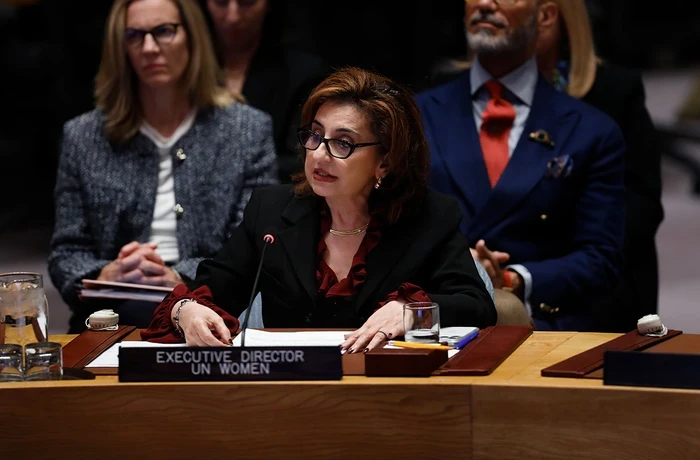
UN Under-Secretary-General and UN Women Executive Director Sima Bahous delivers remarks to the Security Council open debate on women and peace and security, UN headquarters, 27 October 2026. Photo: UN Women/Ryan Brown.
Speech

Speech: Do we have the courage to share power, the resolve to invest in women’s leadership, and the political will to turn our commitments into action?

27 October 2026
Speech: Do we have the courage to share power, the resolve to invest in women’s leadership, and the political will to turn our commitments into action?
Image
UNWomen_Placeholder
Press release

Women and girls’ death toll in armed conflict doubles since 2021

26 October 2026
Women and girls’ death toll in armed conflict doubles since 2021
Image
UNWomen_Placeholder
Press briefing

The UN Secretary General’s report on Women, Peace, and Security

26 October 2026
The UN Secretary General’s report on Women, Peace, and Security

Footer menu-HQ

  • News and stories
  • Resources
  • What we do
  • How we work
  • Where we are
  • Partnerships
  • Employment
  • Procurement
  • Contact us
  • Executive Board
  • Commission on the Status of Women

Donate button menu [Footer tablet]

  • Donate

Donate button menu [Footer]

  • Donate

Social media menu

  • Facebook
  • Twitter
  • LinkedIn
  • Flickr
  • YouTube
  • Instagram
UN Women - For all women and girls

Footer bottom [Menu]

  • Copyright
  • Information security
  • Privacy notice
  • Report wrongdoing
  • Terms of use
Share this page
  • Share to Facebook
  • Share to Twitter
  • Share to LinkedIn
  • Share to E-mail

Or copy link
