
Universal menu

  • Global
  • Regions
    • Africa
    • Americas and the Caribbean
    • Arab States
    • Asia and the Pacific
    • Europe and Central Asia
  • Knowledge
  • Data
  • Training
  • Transparency
UN Women - For all women and girls

Main Navigation-HQ

  • Who we are
    • About us
      • About UN Women
      • Business model
      • Guiding documents
      • Worldwide presence
    • Leadership
      • Governance structure
      • Executive leadership
      • Executive Board
      • Accountability
    • Work with us
      • Employment
      • Procurement
      • Calls for proposals
      • Contact us
      • UN Women Strategic Plan 2026–2029
      • UN Women Strategic Plan 2026–2029 - social media image
        UN Women Strategic Plan 2026–2029
  • What we do
    • Focus areas
      • Ending violence against women
      • Peace and security
      • Humanitarian action
      • Leadership and governance
      • Economic empowerment
      • Innovation and technology
      • Women with disabilities
      • Youth
      • HIV and AIDS
    • How we work
      • 2030 Agenda for Sustainable Development
      • Commission on the Status of Women
      • Gender parity in the UN system
      • Intergovernmental support
      • Partnerships
      • Research and data
      • Training Centre
      • Trust funds
      • UN system coordination
      • Gender Equality Accelerators
      • Gender Equality Accelerators artwork
        Gender Equality Accelerators
  • News and stories
    • Latest
      • News
      • Articles and explainers
      • In focus
    • Media center
      • Press materials
      • Media contacts
      • Explainer: Why are women so exhausted? Care work and the mental load
      • Two adults stand at a table changing diapers on baby dolls, with laundry hanging on a clothesline behind them in a home setting.
        Explainer: Why are women so exhausted? Care work and the mental load
      • Press release: Aid cuts dismantle women’s organizations working in humanitarian crises
      • A young Ugandan woman sits with another local woman to talk
        Press release: Aid cuts dismantle women’s organizations working in humanitarian crises
  • Digital library
    • Resources
      • Publications
      • Annual reports
      • Gender snapshot
      • Progress of the world’s women
      • World survey on the role of women in development
    • GenderTerm
      • GenderTerm
      • Reprint permissions
      • UN Women Highlights 2025–2026
      • A smiling woman.
        UN Women Highlights 2025–2026
      • Gender snapshot 2026
      • A diverse group of people represented as simplified silhouettes, arranged against a dark blue background.
        Gender snapshot 2026
  • Get involved
    • How to get involved
      • For ALL Women and Girls
      • International Women's Day
      • 16 Days of Activism to End Violence against Women and Girls
      • UNiTE! Campaign to End Violence against Women
      • Generation Equality
      • He for She
Ask AI
https://84e5cfacd5c7e99f9825edf344450c.1b.environment.api.powerplatform.com/powervirtualagents/botsbyschema/crad4_websiteQA/directline/token?api-version=2022-03-01-preview
1
-
Ask your question here
AI website assistant

Hello, how can I assist you?

AI chatbot responses may be incorrect. Always verify important information.

Donate button menu

Donate

Breadcrumb

  1. Home
  2. News and stories
  3. Press briefing

Website survey

We want to know how we can improve your experience on this website. Completing this survey takes less than 5 minutes.

TAKE THE SURVEY
Press briefing

Women in the occupied West Bank increasingly cut off from daily life, living in fear amid rising violence and restrictions

As prepared remarks by UN Women Chief of Humanitarian Action Sofia Calltorp – to whom quoted text may be attributed – at today’s press briefing at the Palais des Nations in Geneva.

15 September 2026
  • Share to Facebook
  • Share to Twitter
  • Share to LinkedIn
  • Share to E-mail

[As prepared]

Settler violence, Israeli military operations and movement restrictions across the occupied West Bank have left many women living in fear and increasingly cut off from daily life.

As of 31 January 2026, more than 1,050 Palestinians had been killed by the Israeli security forces since October 2023, 1,025 of whom are men and boys. More than 22,300 people have been detained – the majority of them men and boys.

Behind every one of these figures is a family in grief: a mother waiting for news of her son, a wife left without her partner, and children facing immense loss.

For women who are suddenly left heading households, they must find ways to earn an income, secure assistance, and protect their families under conditions that make even the most basic responsibilities extraordinarily difficult. They face heightened risks of poverty, exclusion, and violence.

Latest estimates suggest that 83,200 households in the occupied West Bank are headed by women – representing one in eight households. But this figure is likely an underestimate.

UN Women has spoken to women across the occupied West Bank and documented the findings in a new analysis published today.

We found that women-headed households are more likely to be displaced – with 40 per cent of households headed by women not living in their original home, compared to 30 per cent of men-headed households.

We found that fear for one’s safety and security is everywhere. Three-quarters of Palestinians that we spoke to told us that they do not feel safe in their daily life. Half told us that the security of their children is of great concern. Fifty-seven per cent of women heading households told us that they were afraid of being arrested – and 76 per cent of men shared the same concern.

Half of women heading households told us that they are skipping meals to cope with food shortages. Two thirds said they are taking out loans to make ends meet – making any recovery much harder to reach.

Movement obstacles – including staffed checkpoints, road barriers, and trenches – are another major driver of daily hardship in the occupied West Bank. There are now an estimated 925 such obstacles – the highest number recorded in two decades.

Every woman heading a household whom we interviewed said she avoids checkpoints altogether, while nine in ten said they make them feel unsafe.

The consequences are severe. Women responsible for feeding their families, securing assistance, and meeting basic needs are being prevented from moving freely to reach food, aid, essential services, and employment. This is restricting their mobility, and undermining their safety, well-being, and ability to keep their families afloat.

Palestinian people – especially women and girls – need this suffering and violence to end. UN Women calls for immediate action to end the violence, movement restrictions, and home demolition in the occupied West Bank, including East Jerusalem – and to protect women and girls, and all civilians, in line with international law.

UN Women calls for dedicated support for women-headed households – support that is disability-inclusive, and combines livelihoods, social protection, health, shelter, and protection services.

UN Women is on the ground in Palestine. We work with women-led organizations across the West Bank providing psychosocial support, protection services, legal assistance, and access to aid.

Despite the immense suffering imposed on them, Palestinian women continue to show extraordinary strength, leadership, and determination. We call on the international community to stand with them in strength and in leadership to protect civilians, respect international law, ensure freedom of movement for people to go about their daily lives, and ensure accountability for the violence.
Topics

  • Humanitarian action
  • Peace and security
  • Conflict, war
  • Post-conflict recovery
  • Arab States/North Africa
  • Palestine, State of

Related content

Image
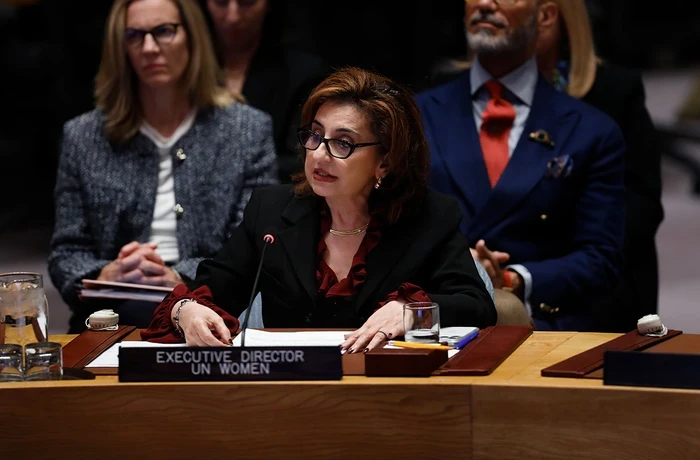
UN Under-Secretary-General and UN Women Executive Director Sima Bahous delivers remarks to the Security Council open debate on women and peace and security, UN headquarters, 27 October 2026. Photo: UN Women/Ryan Brown.
Speech

Speech: Do we have the courage to share power, the resolve to invest in women’s leadership, and the political will to turn our commitments into action?

27 October 2026
Speech: Do we have the courage to share power, the resolve to invest in women’s leadership, and the political will to turn our commitments into action?
Image
UNWomen_Placeholder
Press release

Women and girls’ death toll in armed conflict doubles since 2021

26 October 2026
Women and girls’ death toll in armed conflict doubles since 2021
Image
UNWomen_Placeholder
Press briefing

The UN Secretary General’s report on Women, Peace, and Security

26 October 2026
The UN Secretary General’s report on Women, Peace, and Security

Footer menu-HQ

  • News and stories
  • Resources
  • What we do
  • How we work
  • Where we are
  • Partnerships
  • Employment
  • Procurement
  • Contact us
  • Executive Board
  • Commission on the Status of Women

Donate button menu [Footer tablet]

  • Donate

Donate button menu [Footer]

  • Donate

Social media menu

  • Facebook
  • Twitter
  • LinkedIn
  • Flickr
  • YouTube
  • Instagram
UN Women - For all women and girls

Footer bottom [Menu]

  • Copyright
  • Information security
  • Privacy notice
  • Report wrongdoing
  • Terms of use
Share this page
  • Share to Facebook
  • Share to Twitter
  • Share to LinkedIn
  • Share to E-mail

Or copy link