
Universal menu

  • Global
  • Regions
    • Africa
    • Americas and the Caribbean
    • Arab States
    • Asia and the Pacific
    • Europe and Central Asia
  • Knowledge
  • Data
  • Training
  • Transparency
UN Women - For all women and girls

Main Navigation-HQ

  • Who we are
    • About us
      • About UN Women
      • Business model
      • Guiding documents
      • Worldwide presence
    • Leadership
      • Governance structure
      • Executive leadership
      • Executive Board
      • Accountability
    • Work with us
      • Employment
      • Procurement
      • Calls for proposals
      • Contact us
      • UN Women Strategic Plan 2026–2029
      • UN Women Strategic Plan 2026–2029 - social media image
        UN Women Strategic Plan 2026–2029
  • What we do
    • Focus areas
      • Ending violence against women
      • Peace and security
      • Humanitarian action
      • Leadership and governance
      • Economic empowerment
      • Innovation and technology
      • Women with disabilities
      • Youth
      • HIV and AIDS
    • How we work
      • 2030 Agenda for Sustainable Development
      • Commission on the Status of Women
      • Gender parity in the UN system
      • Intergovernmental support
      • Partnerships
      • Research and data
      • Training Centre
      • Trust funds
      • UN system coordination
      • Gender Equality Accelerators
      • Gender Equality Accelerators artwork
        Gender Equality Accelerators
  • News and stories
    • Latest
      • News
      • Articles and explainers
      • In focus
    • Media center
      • Press materials
      • Media contacts
      • Explainer: Why are women so exhausted? Care work and the mental load
      • Two adults stand at a table changing diapers on baby dolls, with laundry hanging on a clothesline behind them in a home setting.
        Explainer: Why are women so exhausted? Care work and the mental load
      • Press release: Aid cuts dismantle women’s organizations working in humanitarian crises
      • A young Ugandan woman sits with another local woman to talk
        Press release: Aid cuts dismantle women’s organizations working in humanitarian crises
  • Digital library
    • Resources
      • Publications
      • Annual reports
      • Gender snapshot
      • Progress of the world’s women
      • World survey on the role of women in development
    • GenderTerm
      • GenderTerm
      • Reprint permissions
      • UN Women Highlights 2025–2026
      • A smiling woman.
        UN Women Highlights 2025–2026
      • Gender snapshot 2026
      • A diverse group of people represented as simplified silhouettes, arranged against a dark blue background.
        Gender snapshot 2026
  • Get involved
    • How to get involved
      • For ALL Women and Girls
      • International Women's Day
      • 16 Days of Activism to End Violence against Women and Girls
      • UNiTE! Campaign to End Violence against Women
      • Generation Equality
      • He for She
Ask AI
https://84e5cfacd5c7e99f9825edf344450c.1b.environment.api.powerplatform.com/powervirtualagents/botsbyschema/crad4_websiteQA/directline/token?api-version=2022-03-01-preview
1
-
Ask your question here
AI website assistant

Hello, how can I assist you?

AI chatbot responses may be incorrect. Always verify important information.

Donate button menu

Donate

Breadcrumb

  1. Home
  2. News and stories
  3. Press briefing

Website survey

We want to know how we can improve your experience on this website. Completing this survey takes less than 5 minutes.

TAKE THE SURVEY
Press briefing

Press briefing by UN Women on the severe food insecurity crisis in Sudan

Remarks by Salvator Nkurunziza, UN Women Representative in Sudan, speaking at the Palais des Nations in Geneva, from Port Sudan.

5 August 2025
  • Share to Facebook
  • Share to Twitter
  • Share to LinkedIn
  • Share to E-mail

Thank you for joining us today for this briefing on the deepening and severe food insecurity crisis in Sudan – a crisis that is not only humanitarian, but profoundly gendered.

Sudan is on the brink of famine. Conflict, displacement and economic collapse have pushed over 30 million people into acute food insecurity. But behind these numbers lies a stark and devastating truth: women and girls are the hungriest faces of this crisis.

Image
A woman opens a box labelled "UN Women"
Staff from Sudanese Coalition For Education for All (SCEFA), one of UN Women's partners in humanitarian response, distribute kitchen kits to displaced women at the Alazhri gathering site in Port Sudan. Photo: UN Women/Ekram Hamad Fadlalla

Since the conflict started in mid-April 2023, women and girls have been disproportionately affected by the escalating food crisis. And with conditions now near famine thresholds in several regions of the country, it is not just a food crisis but a gender emergency caused by a failure of gender-responsive action. Women and girls are bearing the brunt of severe food insecurity, with fewer resources, less access to aid and greater exposure to risk.

According to the latest Gender Snapshot by the GiHA Working Group, 75 per cent of female-headed households in Sudan are now food insecure. The proportion facing severe food insecurity has nearly doubled in just one year – from 14 per cent in 2024 to nearly 26 per cent in early 2025. Today, female-headed households are three times more likely to be food insecure than those led by men.

This is the result of systemic inequalities, compounded by conflict and displacement. Women are increasingly left to head households alone – due to the death, disappearance or forced displacement of male family members. And yet, they face the greatest barriers to food, income and aid.

Nearly half of all female-headed households report poor food consumption. Only one-third have access to an acceptable diet. And more than 70 per cent of women nationally do not meet minimum dietary diversity standards, putting maternal and child health at grave risk.

But amid this crisis, women are not only victims of conflict – they are also powerful agents of change. Women-led organizations (WLOs) are reaching last-mile communities and saving lives, yet remain underfunded and excluded from key decision-making. By supporting women-led initiatives, we are strengthening the resilience of entire communities.

They are running food kitchens and delivering meals, yet remain under-recognized. One women-led organization operating across eight states was recently forced to shut down more than half of its food kitchens – not because the need had diminished, but because the funding did. We must act – and we must act now.

UN Women calls for the following urgent actions:

  1. Prioritize female-headed households and at-risk groups – including pregnant and breastfeeding women and adolescent girls – in all food assistance.
  2. Fund and elevate women-led food support initiatives with flexible, direct and predictable financing.
  3. Integrate women-led organizations into decision-making at all levels of the humanitarian response.
  4. Link food assistance to protection and recovery, including gender-based violence mitigation and women’s livelihoods.
  5. Track gender outcomes, not just outputs – because tonnage alone does not tell the full story.

In closing, let us not wait for famine to be declared before we act. Let us listen to women, fund their leadership and put gender equality at the heart of our response. Things are getting worse, but with bold, coordinated and gender-responsive action, we can turn the tide.
Topics

  • Gender statistics
  • Humanitarian action
  • Peace and security
  • Conflict, war
  • Africa
  • Sudan

Related content

Image
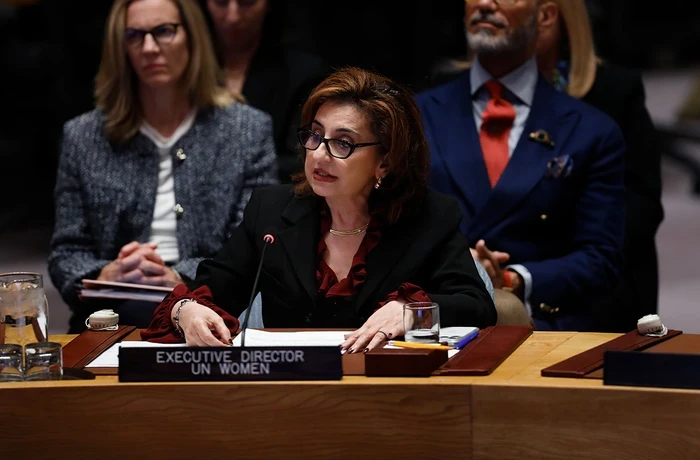
UN Under-Secretary-General and UN Women Executive Director Sima Bahous delivers remarks to the Security Council open debate on women and peace and security, UN headquarters, 27 October 2026. Photo: UN Women/Ryan Brown.
Speech

Speech: Do we have the courage to share power, the resolve to invest in women’s leadership, and the political will to turn our commitments into action?

27 October 2026
Speech: Do we have the courage to share power, the resolve to invest in women’s leadership, and the political will to turn our commitments into action?
Image
UNWomen_Placeholder
Press briefing

The UN Secretary General’s report on Women, Peace, and Security

26 October 2026
The UN Secretary General’s report on Women, Peace, and Security
Image
UNWomen_Placeholder
Press release

Women and girls’ death toll in armed conflict doubles since 2021

26 October 2026
Women and girls’ death toll in armed conflict doubles since 2021

Footer menu-HQ

  • News and stories
  • Resources
  • What we do
  • How we work
  • Where we are
  • Partnerships
  • Employment
  • Procurement
  • Contact us
  • Executive Board
  • Commission on the Status of Women

Donate button menu [Footer tablet]

  • Donate

Donate button menu [Footer]

  • Donate

Social media menu

  • Facebook
  • Twitter
  • LinkedIn
  • Flickr
  • YouTube
  • Instagram
UN Women - For all women and girls

Footer bottom [Menu]

  • Copyright
  • Information security
  • Privacy notice
  • Report wrongdoing
  • Terms of use
Share this page
  • Share to Facebook
  • Share to Twitter
  • Share to LinkedIn
  • Share to E-mail

Or copy link