Universal menu

  • Global
  • Regions
    • Africa
    • Americas and the Caribbean
    • Arab States
    • Asia and the Pacific
    • Europe and Central Asia
  • Knowledge
  • Data
  • Training
  • Transparency
UN Women - For all women and girls

Main Navigation-HQ

  • Who we are
    • About us
      • About UN Women
      • Business model
      • Guiding documents
      • Worldwide presence
    • Leadership
      • Governance structure
      • Executive leadership
      • Executive Board
      • Accountability
    • Work with us
      • Employment
      • Procurement
      • Calls for proposals
      • Contact us
      • UN Women Strategic Plan 2026–2029
      • UN Women Strategic Plan 2026–2029 - social media image
        UN Women Strategic Plan 2026–2029
  • What we do
    • Focus areas
      • Ending violence against women
      • Peace and security
      • Humanitarian action
      • Leadership and governance
      • Economic empowerment
      • Innovation and technology
      • Women with disabilities
      • Youth
      • HIV and AIDS
    • How we work
      • 2030 Agenda for Sustainable Development
      • Commission on the Status of Women
      • Gender parity in the UN system
      • Intergovernmental support
      • Partnerships
      • Research and data
      • Training Centre
      • Trust funds
      • UN system coordination
      • Gender Equality Accelerators
      • Gender Equality Accelerators artwork
        Gender Equality Accelerators
  • News and stories
    • Latest
      • News
      • Articles and explainers
      • In focus
    • Media center
      • Press materials
      • Media contacts
      • Explainer: Why are women so exhausted? Care work and the mental load
      • Two adults stand at a table changing diapers on baby dolls, with laundry hanging on a clothesline behind them in a home setting.
        Explainer: Why are women so exhausted? Care work and the mental load
      • Press release: Aid cuts dismantle women’s organizations working in humanitarian crises
      • A young Ugandan woman sits with another local woman to talk
        Press release: Aid cuts dismantle women’s organizations working in humanitarian crises
  • Digital library
    • Resources
      • Publications
      • Annual reports
      • Gender snapshot
      • Progress of the world’s women
      • World survey on the role of women in development
    • GenderTerm
      • GenderTerm
      • Reprint permissions
      • UN Women Highlights 2025–2026
      • A smiling woman.
        UN Women Highlights 2025–2026
      • Gender snapshot 2026
      • A diverse group of people represented as simplified silhouettes, arranged against a dark blue background.
        Gender snapshot 2026
  • Get involved
    • How to get involved
      • For ALL Women and Girls
      • International Women's Day
      • 16 Days of Activism to End Violence against Women and Girls
      • UNiTE! Campaign to End Violence against Women
      • Generation Equality
      • He for She
Ask AI
https://84e5cfacd5c7e99f9825edf344450c.1b.environment.api.powerplatform.com/powervirtualagents/botsbyschema/crad4_websiteQA/directline/token?api-version=2022-03-01-preview
1
-
Ask your question here
AI website assistant

Hello, how can I assist you?

AI chatbot responses may be incorrect. Always verify important information.

Donate button menu

Donate

Breadcrumb

  1. Home
  2. News and stories
  3. Press briefing

Website survey

We want to know how we can improve your experience on this website. Completing this survey takes less than 5 minutes.

TAKE THE SURVEY
Press briefing

Press briefing by UN Women on the impact on women and girls of two years of relentless conflict in Sudan

By Sofia Calltorp, UN Women’s Chief of Humanitarian Action and Director of the Geneva Office, at the Palais des Nations in Geneva.

11 April 2025
  • Share to Facebook
  • Share to Twitter
  • Share to LinkedIn
  • Share to E-mail

Almost two years ago, on April 15, the conflict in Sudan ignited a crisis now labeled the worst humanitarian emergency in the world for women and girls.  

Since then, the toll on their lives, livelihoods, and dignity has intensified beyond measure, and women and girls are once again suffering the worst of the consequences. 

Today, more than six million displaced Sudanese women and girls face daily threats to their safety and basic survival. 

Image
When the conflict erupted in Khartoum, Ruweda and hersiblings fled without their father. Its been a whole year since they last saw him.. Kassala state, March 2024. Photo: UNICEF/UNI547360/Ahmed Mohamdeen Elfatih.
When the conflict erupted in Khartoum, Ruweda and her siblings fled without their father. Its been a whole year since they last saw him. Kassala state, March 2024. Photo: UNICEF/UNI547360/Ahmed Mohamdeen Elfatih.

In just two years, the number of people at risk of gender-based violence, including sexual violence, has tripled to over 12 million.  

These statistics, shocking as they are, only scratch the surface: many survivors of conflict-related sexual violence never report their experiences for fear of stigma and retaliation. The weaponization of sexual violence against women in Sudan must stop, and perpetrators must face justice. 

As half of the country’s population already face hunger and the food security crisis increasingly worsens, women are especially vulnerable, often being the last to eat, and because of social norms around food distribution and their more limited financial resources and social support. 

With 80 percent of hospitals in conflict-affected areas not functioning, maternal deaths have risen alarmingly, and 80 percent of displaced women also lack access to clean water. 

These numbers are not just statistics—they are stories of profound suffering and urgent need. That is why I will be travelling to Sudan in the coming days to hear from the Sudanese women who have displayed extraordinary resilience in these difficult moments.  

They have stepped forward as frontline responders, peacebuilders, and advocates for their communities, despite being excluded from the initial peace negotiations. Amplifying women’s voices in every peace negotiation and in humanitarian decision-making spaces is an imperative for a just and lasting peace. 

Over the past two years, UN Women has partnered with more than 60 women-led organizations to reach over 15,000 women in some of Sudan’s most affected areas — providing access to safe shelter, mental health care, and legal aid, while also gaining access to key spaces to have their voices heard in local and international arenas. Yet the needs are vast, and more funding is crucial.  

As the conflict reaches its two-year mark, we renew our hope for its end to come, as well as the immediate cessation of all forms of gender-based violence, including sexual violence. 

Sudan’s ongoing transition remains complex, but recent efforts by the Government to restore security in parts of the country—including Khartoum—demonstrate potential for progress. Moving forward, it is imperative to bolster these gains by safeguarding human rights and prioritizing the prevention of all forms of abuse, particularly against women and girls, in both return and IDP areas. 

Sudanese women and girls deserve more than survival; they deserve the dignity, resources, and opportunities to rebuild their lives and their nation. When women are centered in recovery and peacebuilding, entire communities heal. 

Thank you.
Topics

  • Conflict, war
  • Sexual violence in conflict
  • Peacebuilding
  • Africa
  • Sudan

Related content

Image
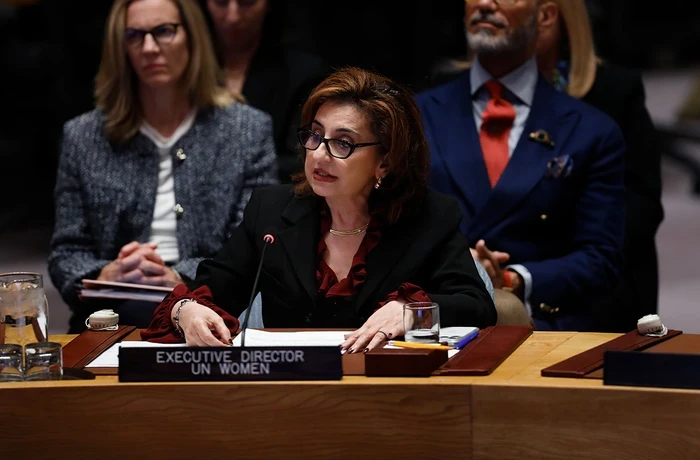
UN Under-Secretary-General and UN Women Executive Director Sima Bahous delivers remarks to the Security Council open debate on women and peace and security, UN headquarters, 27 October 2026. Photo: UN Women/Ryan Brown.
Speech

Speech: Do we have the courage to share power, the resolve to invest in women’s leadership, and the political will to turn our commitments into action?

27 October 2026
Speech: Do we have the courage to share power, the resolve to invest in women’s leadership, and the political will to turn our commitments into action?
Image
UNWomen_Placeholder
Press release

Women and girls’ death toll in armed conflict doubles since 2021

26 October 2026
Women and girls’ death toll in armed conflict doubles since 2021
Image
UNWomen_Placeholder
Press briefing

The UN Secretary General’s report on Women, Peace, and Security

26 October 2026
The UN Secretary General’s report on Women, Peace, and Security

Footer menu-HQ

  • News and stories
  • Resources
  • What we do
  • How we work
  • Where we are
  • Partnerships
  • Employment
  • Procurement
  • Contact us
  • Executive Board
  • Commission on the Status of Women

Donate button menu [Footer tablet]

  • Donate

Donate button menu [Footer]

  • Donate

Social media menu

  • Facebook
  • Twitter
  • LinkedIn
  • Flickr
  • YouTube
  • Instagram
UN Women - For all women and girls

Footer bottom [Menu]

  • Copyright
  • Information security
  • Privacy notice
  • Report wrongdoing
  • Terms of use
Share this page
  • Share to Facebook
  • Share to Twitter
  • Share to LinkedIn
  • Share to E-mail

Or copy link