
Universal menu

  • Global
  • Regions
    • Africa
    • Americas and the Caribbean
    • Arab States
    • Asia and the Pacific
    • Europe and Central Asia
  • Knowledge
  • Data
  • Training
  • Transparency
UN Women - For all women and girls

Main Navigation-HQ

  • Who we are
    • About us
      • About UN Women
      • Business model
      • Guiding documents
      • Worldwide presence
    • Leadership
      • Governance structure
      • Executive leadership
      • Executive Board
      • Accountability
    • Work with us
      • Employment
      • Procurement
      • Calls for proposals
      • Contact us
      • UN Women Strategic Plan 2026–2029
      • UN Women Strategic Plan 2026–2029 - social media image
        UN Women Strategic Plan 2026–2029
  • What we do
    • Focus areas
      • Ending violence against women
      • Peace and security
      • Humanitarian action
      • Leadership and governance
      • Economic empowerment
      • Innovation and technology
      • Women with disabilities
      • Youth
      • HIV and AIDS
    • How we work
      • 2030 Agenda for Sustainable Development
      • Commission on the Status of Women
      • Gender parity in the UN system
      • Intergovernmental support
      • Partnerships
      • Research and data
      • Training Centre
      • Trust funds
      • UN system coordination
      • Gender Equality Accelerators
      • Gender Equality Accelerators artwork
        Gender Equality Accelerators
  • News and stories
    • Latest
      • News
      • Articles and explainers
      • In focus
    • Media center
      • Press materials
      • Media contacts
      • Explainer: Why are women so exhausted? Care work and the mental load
      • Two adults stand at a table changing diapers on baby dolls, with laundry hanging on a clothesline behind them in a home setting.
        Explainer: Why are women so exhausted? Care work and the mental load
      • Press release: Aid cuts dismantle women’s organizations working in humanitarian crises
      • A young Ugandan woman sits with another local woman to talk
        Press release: Aid cuts dismantle women’s organizations working in humanitarian crises
  • Digital library
    • Resources
      • Publications
      • Annual reports
      • Gender snapshot
      • Progress of the world’s women
      • World survey on the role of women in development
    • GenderTerm
      • GenderTerm
      • Reprint permissions
      • UN Women Highlights 2025–2026
      • A smiling woman.
        UN Women Highlights 2025–2026
      • Gender snapshot 2026
      • A diverse group of people represented as simplified silhouettes, arranged against a dark blue background.
        Gender snapshot 2026
  • Get involved
    • How to get involved
      • For ALL Women and Girls
      • International Women's Day
      • 16 Days of Activism to End Violence against Women and Girls
      • UNiTE! Campaign to End Violence against Women
      • Generation Equality
      • He for She
Ask AI
https://84e5cfacd5c7e99f9825edf344450c.1b.environment.api.powerplatform.com/powervirtualagents/botsbyschema/crad4_websiteQA/directline/token?api-version=2022-03-01-preview
1
-
Ask your question here
AI website assistant

Hello, how can I assist you?

AI chatbot responses may be incorrect. Always verify important information.

Donate button menu

Donate

Breadcrumb

  1. Home
  2. News and stories
  3. Op-ed

Website survey

We want to know how we can improve your experience on this website. Completing this survey takes less than 5 minutes.

TAKE THE SURVEY
Op-ed

Op-ed: Technology and Gender Equality – bringing women and girls to the centre of innovation

14 March 2023
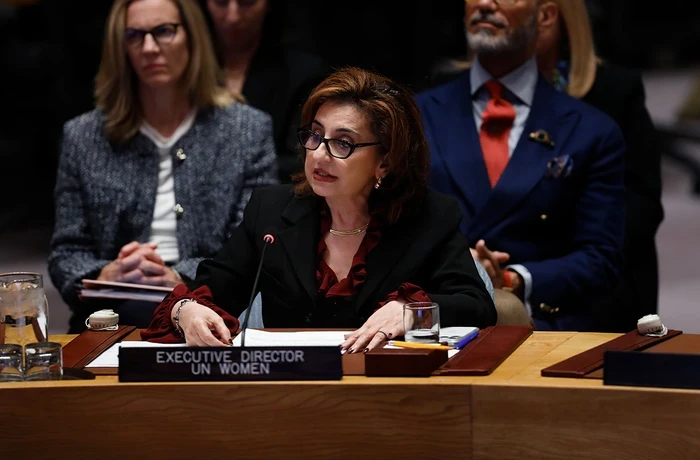
UN Women Executive Director Sima Bahous
  • Share to Facebook
  • Share to Twitter
  • Share to LinkedIn
  • Share to E-mail

The 67th Session of the Commission on the Status of Women is a global opportunity for us to celebrate the achievements of women and girls around the world, and to deepen our resolve to accelerate progress on gender equality.  

In dealing with a major issue at the centre of the advancement of women and girls, this year’s focus on innovation and technology for gender equality could not be timelier—nor more important.   

Innovation and technological change are deep shifts reshaping life in the 21st century. Technological progress allows for unprecedented advances with the potential to improve social, economic and political outcomes for all.  

Yet these advances and outcomes are not equally shared. Three billion people remain unconnected to the internet, the majority of whom are women and girls. Women also lag men in the effective use of technology as that capability interacts with other dimensions of discrimination, such as education and skills gaps and curbs on autonomy. As the online world becomes more important in people’s lives, the acceleration of technological change heightens the risk of further entrenching these inequalities.  

Women and girls have made significant contributions to human innovation, yet remain underrepresented in science, technology, engineering, and mathematics.  They are only 35% of students in STEM education. Women hold less than one third of positions in the technology sector and hold only 22 per cent of jobs in the artificial intelligence arena.  

The result of these discrepancies is seen not only in the casual misogyny of the high-tech workplace, from which women continue to drop out at alarming rates, but also  in the products and services being produced by high-tech firms, with unconscious bias and inequality quite literally written into the code of the most broadly used technologies. 

Image
Elena Sam Pec, pictured as she takes a phone call on one phone while checking a text message on another, lives in Puente Viejo, Guatemala, a mostly agrarian indigenous community that relies on wooden canoes to transport their products or to access services. Digital technology can help better connect rural women like Elena with services and resources, but a lack of inclusive design means marginalized groups often stand to benefit least from new innovations. Photo: UN Women/Ryan Brown

Elena Sam Pec, pictured as she takes a phone call on one phone while checking a text message on another, lives in Puente Viejo, Guatemala, a mostly agrarian indigenous community that relies on wooden canoes to transport their products or to access services. Digital technology can help better connect rural women like Elena with services and resources, but a lack of inclusive design means marginalized groups often stand to benefit least from new innovations. Photo: UN Women/Ryan Brown

The future of technology must not be a future of inequality

Digital activism and the power of movements like #MeToo demonstrate without doubt the power of collective digital action to promote change. However social media has also given rise to gendered disinformation, misinformation, online violence and sexist hate speech, targeting women as well as LGBTQ+ persons, human rights defenders, politicians and journalists everywhere, and concerns are growing that emerging AI tech may be deployed to further these unconscionable tendencies. 

Baseless online attacks are assaults on democracy and inclusion. They seek to silence women’s voices, discourage them from running for public office or advocating for their rights. As the development of artificial intelligence accelerates, the risk of biases becoming even more deeply entrenched in the systems of our lives is growing exponentially.  

If the challenges seem steep, the ongoing 67th Session of the Commission on the Status of Women can be a powerful course-corrector. We must all show the women and men of the world that we are not daunted. We can, and we must, ensure that humanity prevails in the digital space, even when it is found wanting in real life. This Session is our collective chance to strengthen the normative framework around gender and technology, and at a key moment in advance of the Global Digital Compact, which will be part of the Secretary-General’s Summit of the Future in 2024. 

The Secretary-General’s report informing the Commission is clear in its recommendations. We must prioritize equal and meaningful access for all women and girls, that allows a safe, satisfying, productive and affordable online experience. Technology must promote women’s and girls’ equal rights and opportunities to learn, have their voices heard, access key services, expand their businesses or access financial products. 

We must push back against gender-based violence and the colossal impunity enjoyed by perpetrators and the digital platforms that amplify and funnel targeted attacks on women and girls. In short, we must ensure that technology amplifies women’s voices, so that they may have stronger impact on the future course of our world. 

Image
At a workshop organized by UN Women’s Arab States Regional Office and UNESCO, girls and young women aged 12 to 30 learned how to code and construct robots. The workshop focused on the hands-on interaction and assembly of robotics kits and participants’ introduction to coding/programming that would allow them to control their creations.
At a workshop organized by UN Women’s Arab States Regional Office and UNESCO, girls and young women aged 12 to 30 learned how to code and construct robots. The workshop focused on the hands-on interaction and assembly of robotics kits and participants’ introduction to coding/programming that would allow them to control their creations. The event was part of the SHECAN initiative, which aims to inspire and engage girls and young women around science, technology, engineering and mathematics (STEM) and raise their interest in possible careers in emerging technology fields. Photo: UN Women/Emad Karim

Diversity is critical to ensure technology meets everyone’s needs

Promoting gender equality in the realm of technology is indeed a matter of rights, but it goes beyond questions of justice. Women’s equal leadership in tech spaces will ensure that the technology of our future fosters’ sustainability and inclusion, not breakdown and division. Bringing women’s perspectives into science and technology will help the sector to understand that innovation needs to extend beyond the purely technical. Diversity is critical in tech, as it enables companies to create better and safer products that take everyone into consideration. 

However, we will only achieve the progress we seek, and the products women and girls want, when we ensure that they are equally represented across all spheres of decision making. Women policymakers are bringing important perspective to regulatory discussions. Women technologists are rejecting outdated models and putting inclusion and safety at the heart of their work.  In every sphere, women’s rights and contributions are vital for a future where technology serves humanity, not the other way around. What is needed is for these contributions to be more centrally embraced, and to begin to foster change with urgency and at scale.  

Bringing women and girls to the centre of technology requires collective action

More than ever, this year’s priority theme calls upon us all to take collective action. We must ensure that global technology platforms are based on human rights, openness and accountability.  We must address the power asymmetries between the owners and users of digital services and the proliferation of technical companies that dominate the digital landscape without adequate safeguards or accountability. We must foster collaboration across governments, civil society, private sector, and the technical community to ensure the benefits of digital technologies are equally distributed.  

To forge the future we need, women and girls must be front and centre, leading the way, including in the realm of technology. Our future, everyone’s future, depends on it—online and offline.  
Originally published by the UN Chronicle 

Topics

  • Gender equality and women’s empowerment
  • Innovation and technology
  • Commission on the Status of Women
  • UN Women administration
  • Executive Director

Related content

Image
UN Under-Secretary-General and UN Women Executive Director Sima Bahous delivers remarks to the Security Council open debate on women and peace and security, UN headquarters, 27 October 2026. Photo: UN Women/Ryan Brown.
Speech

Speech: Do we have the courage to share power, the resolve to invest in women’s leadership, and the political will to turn our commitments into action?

27 October 2026
Speech: Do we have the courage to share power, the resolve to invest in women’s leadership, and the political will to turn our commitments into action?
Image
UN Women Executive Director Sima Bahous speaks at the High-Level Dialogue on Reinvigorating Feminist Multilateralism held at the UN Headquarters during the High-Level week of the 81st session of the UN General Assembly on 25 September 2026.  Photo: UN Women/Ryan Brown
Speech

Speech: Multilateralism will only remain fit for purpose if it shares power, centres women’s leadership, and delivers for the people it serves

25 September 2026
Speech: Multilateralism will only remain fit for purpose if it shares power, centres women’s leadership, and delivers for the people it serves
Image
UN Women Executive Director Sima Bahous poses with the Prime Minister of Croatia at an indoor event.
News

Governments, civil society, and private sector call for coordinated action to end technology-facilitated violence against women and girls

25 September 2026
Governments, civil society, and private sector call for coordinated action to end technology-facilitated violence against women and girls

Footer menu-HQ

  • News and stories
  • Resources
  • What we do
  • How we work
  • Where we are
  • Partnerships
  • Employment
  • Procurement
  • Contact us
  • Executive Board
  • Commission on the Status of Women

Donate button menu [Footer tablet]

  • Donate

Donate button menu [Footer]

  • Donate

Social media menu

  • Facebook
  • Twitter
  • LinkedIn
  • Flickr
  • YouTube
  • Instagram
UN Women - For all women and girls

Footer bottom [Menu]

  • Copyright
  • Information security
  • Privacy notice
  • Report wrongdoing
  • Terms of use
Share this page
  • Share to Facebook
  • Share to Twitter
  • Share to LinkedIn
  • Share to E-mail

Or copy link