
Universal menu

  • Global
  • Regions
    • Africa
    • Americas and the Caribbean
    • Arab States
    • Asia and the Pacific
    • Europe and Central Asia
  • Knowledge
  • Data
  • Training
  • Transparency
UN Women - For all women and girls

Main Navigation-HQ

  • Who we are
    • About us
      • About UN Women
      • Business model
      • Guiding documents
      • Worldwide presence
    • Leadership
      • Governance structure
      • Executive leadership
      • Executive Board
      • Accountability
    • Work with us
      • Employment
      • Procurement
      • Calls for proposals
      • Contact us
      • UN Women Strategic Plan 2026–2029
      • UN Women Strategic Plan 2026–2029 - social media image
        UN Women Strategic Plan 2026–2029
  • What we do
    • Focus areas
      • Ending violence against women
      • Peace and security
      • Humanitarian action
      • Leadership and governance
      • Economic empowerment
      • Innovation and technology
      • Women with disabilities
      • Youth
      • HIV and AIDS
    • How we work
      • 2030 Agenda for Sustainable Development
      • Commission on the Status of Women
      • Gender parity in the UN system
      • Intergovernmental support
      • Partnerships
      • Research and data
      • Training Centre
      • Trust funds
      • UN system coordination
      • Gender Equality Accelerators
      • Gender Equality Accelerators artwork
        Gender Equality Accelerators
  • News and stories
    • Latest
      • News
      • Articles and explainers
      • In focus
    • Media center
      • Press materials
      • Media contacts
      • Explainer: Why are women so exhausted? Care work and the mental load
      • Two adults stand at a table changing diapers on baby dolls, with laundry hanging on a clothesline behind them in a home setting.
        Explainer: Why are women so exhausted? Care work and the mental load
      • Press release: Aid cuts dismantle women’s organizations working in humanitarian crises
      • A young Ugandan woman sits with another local woman to talk
        Press release: Aid cuts dismantle women’s organizations working in humanitarian crises
  • Digital library
    • Resources
      • Publications
      • Annual reports
      • Gender snapshot
      • Progress of the world’s women
      • World survey on the role of women in development
    • GenderTerm
      • GenderTerm
      • Reprint permissions
      • UN Women Highlights 2025–2026
      • A smiling woman.
        UN Women Highlights 2025–2026
      • Gender snapshot 2026
      • A diverse group of people represented as simplified silhouettes, arranged against a dark blue background.
        Gender snapshot 2026
  • Get involved
    • How to get involved
      • For ALL Women and Girls
      • International Women's Day
      • 16 Days of Activism to End Violence against Women and Girls
      • UNiTE! Campaign to End Violence against Women
      • Generation Equality
      • He for She
Ask AI
https://84e5cfacd5c7e99f9825edf344450c.1b.environment.api.powerplatform.com/powervirtualagents/botsbyschema/crad4_websiteQA/directline/token?api-version=2022-03-01-preview
1
-
Ask your question here
AI website assistant

Hello, how can I assist you?

AI chatbot responses may be incorrect. Always verify important information.

Donate button menu

Donate

Breadcrumb

  1. Home
  2. News and stories
  3. Interview

Website survey

We want to know how we can improve your experience on this website. Completing this survey takes less than 5 minutes.

TAKE THE SURVEY
Interview

‘Women try and make peace’ – Interview with Kenyan jurist Effie Owuor

1 November 2024
  • Share to Facebook
  • Share to Twitter
  • Share to LinkedIn
  • Share to E-mail

Effie Owuor made history when she joined the Kenyan attorney general’s chambers as the country’s first female state council in 1967. In the years that followed, she became the first woman to serve as a senior magistrate, high court judge, and appeals court judge in Kenya.

She founded the Kenya Women Judges Association, and made landmark rulings affecting constitutional law, elections, and criminal and civil matters.

Owour, now retired from the judiciary, has most recently worked on the African Union’s Panel of the Wise, where she deployed across the continent to mediate and observe conflicts. As the co-chair of FemWise-Africa, she champions the role of African women in conflict prevention and mediation.

Owour recently spoke with UN Women about the challenges women face in conflict, as well as their invaluable role in peace processes.

Image
Portrait of Justice Effie Owuor of Kenya.
Portrait of Justice Effie Owuor of Kenya. Photo: UN Women/Ryan Brown

Women have made much progress—but more remains to be done

I began taking interest in women’s issues as far back as 1975. By then, I was a judge over the Kenya High Court. And we were so far behind on issues of women rights. Basically, the women’s world was a different world.

Things have changed, and changed a lot. By the time we came to Beijing [for the 1996 Fourth World Conference on Women], there were many more women judges coming onto the bench, and many more women lawyers. In most of the African countries, the legal field was attracting many, many more women judges and lawyers than it had done before.

Nonetheless, from that time up to now, you have more responsibilities outside your work simply because you are a woman judge. You find yourself having to do a lot of work on women’s rights, and much more is demanded of you.

We haven’t attained everything that we would want to, in all countries.

Women must have decision-making power in peace processes

For each peace mission that we have, we are now demanding for women to make up 30 per cent of delegations—and we are hoping that we can get it up to 50 per cent.

Women mediators are doing so much work in the grassroots. For instance, if there is a problem of water—a town on one side of a river takes more water than a town on the other side—it is often women who work to negotiate. They try and resolve issues through local organizations.

What we now want is to move from that grassroots level. When we are asking for greater percentages of women in peace talks, we are not asking for that grassroots level—we are asking to be at the actual peace table, where the final decisions are made.

We are hardly ever at that level. That means, by the time peace accords and peace agreements come out, issues affecting women are not being addressed at all.

Ensuring women in conflict are not forgotten

When women are at the table, there is someone at negotiations to ask: what’s going to happen to women when they return home?

The men may say, “You will all go home, and you will all get five acres of land.” But that is to the head of a family; what about women returnees?

They may have run away when they were little girls; they may have been refugees; they may have produced children; they may have been raped by a soldier or by someone else. When a woman refugee comes back to her country, the first thing she’ll be asked is, “Who is the father of your child? Is this child a Kenyan? Or is this a Somali?”

There are insensitive things like that. If it’s only men at the table, it is not in their interest to deal with these issues. But if there are women there, these are their biggest problems.

So, gender sensitivity and equality need to be at the very top; we want women to go and negotiate things that affect us.

You can’t have of your population happy and peaceful while the other half is suffering.

It all starts with peace

Where there is no peace, there is very little development that takes place. How can people worry about other things—education, health, what have you—when there is no peace? What education can you worry about when you are busy running from one place to another, when you live in a camp?

For me, peace is issue number one; peace is issue number two; number three—up to number ten. You can’t compare the development of countries that are at war with those that are not at war.

Things are changing in the peace building movement. Young women have to come in. They have to have their space. After all, we are talking about things that are going to affect them. We are trying very hard mentor young people, to help them move to the next level.

Young women must be involved—if they’re not involved, then what happens tomorrow?

Working across borders to end conflict

Women don’t make war in negotiation meetings, when we can go to them. Women try and make peace.

A week ago, we had a meeting between women from the DRC and Rwanda. They didn’t talk about war, they talked about how they can ask their governments to make sure that there is peace.

In their own way, women can cross borders at any given time to try and make things better for each other. Women in Gaza, women in Ukraine—the problems are different, but they are worried about themselves, about their families.

When it comes to peace, I believe that if women can get involved in peacebuilding and conflict resolution, the world would be a better place.

Topics

  • Peace and security
  • Peacebuilding

Related content

Image
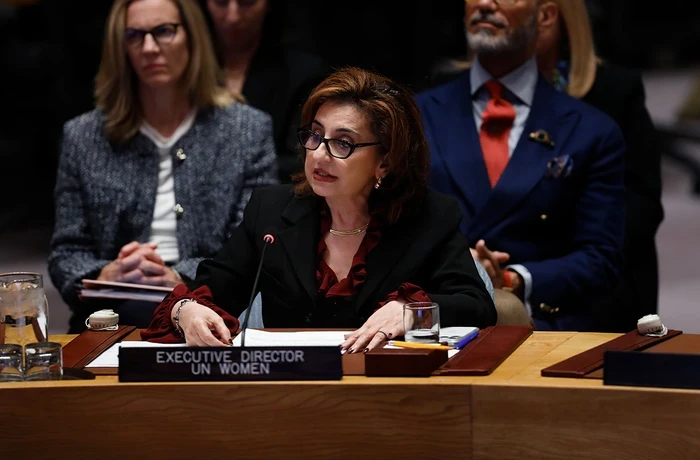
UN Under-Secretary-General and UN Women Executive Director Sima Bahous delivers remarks to the Security Council open debate on women and peace and security, UN headquarters, 27 October 2026. Photo: UN Women/Ryan Brown.
Speech

Speech: Do we have the courage to share power, the resolve to invest in women’s leadership, and the political will to turn our commitments into action?

27 October 2026
Speech: Do we have the courage to share power, the resolve to invest in women’s leadership, and the political will to turn our commitments into action?
Image
UNWomen_Placeholder
Press briefing

The UN Secretary General’s report on Women, Peace, and Security

26 October 2026
The UN Secretary General’s report on Women, Peace, and Security
Image
UNWomen_Placeholder
Press release

Women and girls’ death toll in armed conflict doubles since 2021

26 October 2026
Women and girls’ death toll in armed conflict doubles since 2021

Footer menu-HQ

  • News and stories
  • Resources
  • What we do
  • How we work
  • Where we are
  • Partnerships
  • Employment
  • Procurement
  • Contact us
  • Executive Board
  • Commission on the Status of Women

Donate button menu [Footer tablet]

  • Donate

Donate button menu [Footer]

  • Donate

Social media menu

  • Facebook
  • Twitter
  • LinkedIn
  • Flickr
  • YouTube
  • Instagram
UN Women - For all women and girls

Footer bottom [Menu]

  • Copyright
  • Information security
  • Privacy notice
  • Report wrongdoing
  • Terms of use
Share this page
  • Share to Facebook
  • Share to Twitter
  • Share to LinkedIn
  • Share to E-mail

Or copy link