
Universal menu

  • Global
  • Regions
    • Africa
    • Americas and the Caribbean
    • Arab States
    • Asia and the Pacific
    • Europe and Central Asia
  • Knowledge
  • Data
  • Training
  • Transparency
UN Women - For all women and girls

Main Navigation-HQ

  • Who we are
    • About us
      • About UN Women
      • Business model
      • Guiding documents
      • Worldwide presence
    • Leadership
      • Governance structure
      • Executive leadership
      • Executive Board
      • Accountability
    • Work with us
      • Employment
      • Procurement
      • Calls for proposals
      • Contact us
      • UN Women Strategic Plan 2026–2029
      • UN Women Strategic Plan 2026–2029 - social media image
        UN Women Strategic Plan 2026–2029
  • What we do
    • Focus areas
      • Ending violence against women
      • Peace and security
      • Humanitarian action
      • Leadership and governance
      • Economic empowerment
      • Innovation and technology
      • Women with disabilities
      • Youth
      • HIV and AIDS
    • How we work
      • 2030 Agenda for Sustainable Development
      • Commission on the Status of Women
      • Gender parity in the UN system
      • Intergovernmental support
      • Partnerships
      • Research and data
      • Training Centre
      • Trust funds
      • UN system coordination
      • Gender Equality Accelerators
      • Gender Equality Accelerators artwork
        Gender Equality Accelerators
  • News and stories
    • Latest
      • News
      • Articles and explainers
      • In focus
    • Media center
      • Press materials
      • Media contacts
      • Explainer: Why are women so exhausted? Care work and the mental load
      • Two adults stand at a table changing diapers on baby dolls, with laundry hanging on a clothesline behind them in a home setting.
        Explainer: Why are women so exhausted? Care work and the mental load
      • Press release: Aid cuts dismantle women’s organizations working in humanitarian crises
      • A young Ugandan woman sits with another local woman to talk
        Press release: Aid cuts dismantle women’s organizations working in humanitarian crises
  • Digital library
    • Resources
      • Publications
      • Annual reports
      • Gender snapshot
      • Progress of the world’s women
      • World survey on the role of women in development
    • GenderTerm
      • GenderTerm
      • Reprint permissions
      • UN Women Highlights 2025–2026
      • A smiling woman.
        UN Women Highlights 2025–2026
      • Gender snapshot 2026
      • A diverse group of people represented as simplified silhouettes, arranged against a dark blue background.
        Gender snapshot 2026
  • Get involved
    • How to get involved
      • For ALL Women and Girls
      • International Women's Day
      • 16 Days of Activism to End Violence against Women and Girls
      • UNiTE! Campaign to End Violence against Women
      • Generation Equality
      • He for She
Ask AI
https://84e5cfacd5c7e99f9825edf344450c.1b.environment.api.powerplatform.com/powervirtualagents/botsbyschema/crad4_websiteQA/directline/token?api-version=2022-03-01-preview
1
-
Ask your question here
AI website assistant

Hello, how can I assist you?

AI chatbot responses may be incorrect. Always verify important information.

Donate button menu

Donate

Breadcrumb

  1. Home
  2. News and stories
  3. Feature story

Website survey

We want to know how we can improve your experience on this website. Completing this survey takes less than 5 minutes.

TAKE THE SURVEY
Feature

Voices from Gaza: Hayam’s story 

25 October 2023
  • Share to Facebook
  • Share to Twitter
  • Share to LinkedIn
  • Share to E-mail

“We thank God every day we wake up alive. We are like funerals postponed, dressed and ready to die, waiting for our turn.”

In southern Gaza, 44-year-old Hayam Farahat is navigating life with her family amid the ongoing crisis.

Image
Hayam Farahat’s family home is seen after an Israeli airstrike in Tal al-Hawa, Gaza, on 9 October 2023.
Hayam Farahat’s family home is seen after an Israeli airstrike in Tal al-Hawa, Gaza, on 9 October 2023. Photo: Mohammad Farahat.

When Israeli airstrikes in Rafah prompted them to flee their home, Farahat, along with her daughters Farah and Rahaf, her son Ali, and her husband, grabbed essential documents and supplies and relocated to a nearby house with about 60 others, representing 10 families seeking shelter.

“It’s a terrifying situation”, Farahat said. “We can’t move, we can’t sit comfortably, and even basic needs have become unattainable dreams.”

About 25 children are in the 100-square-meter space, which has restricted food and water and very limited electricity. A single phone acts as their lifeline to the world outside. However, Farahat noted, nearby shelters are even more densely packed and suffer from more extreme food shortages. Entire neighbourhoods in a local refugee camp have been levelled by Israeli airstrikes.

Farahat distracts the young ones with games, while ensuring they are well-prepared to cover their ears for the next round of airstrikes. She also manages her family’s food and water, ensuring that nobody goes hungry. Among the essential documents she took when she fled her home were medical reports about her son’s laryngomalacia, a congenital issue with the larynx which can cause difficulty breathing.

Before the crisis, Farahat worked in the Women’s Affairs Centre, an independent Palestinian nonprofit and UN Women partner that works for women’s rights and gender equality in Gaza through research, capacity development, and advocacy programmes.

Farahat holds a Jordanian passport that could allow her to relocate to safety—but her children do not, so leaving is not an option. She and her family have decided to stay where they are, bracing themselves for each new day.

“We exist in a state of limbo”, she said. In the makeshift shelter, Farahat has guided others through fear and anxiety while managing her own feelings of distress, and has helped her daughters do the same.

“My daughters are providing support to three elderly women in the house, one with diabetes, another one with high blood pressure, and another with cancer”, Farahat said.

But despite her work providing support to others, the psychological burden of living through such a crisis is taking a toll, Farahat said.

“We can’t take this anymore”, she said. Their grief is compounded by the loss of relatives they cannot visit, trapped by the dangers that lurk outside. Every morning, Farahat and her family wake up and give thanks for their safety.

“We are waiting, wondering when it will be our turn to face the unthinkable”, she said. As she spoke, air strikes again exploded and Farahat said she must leave to be with her family. She ended the conversation by saying that her deepest wish was that, if they were hit by an airstrike, that it would happen while she and her family slept. 
Topics

  • Humanitarian action
  • Crisis response and recovery
  • Peace and security
  • Conflict, war
  • Arab States/North Africa
  • Palestine, State of

Related content

Image
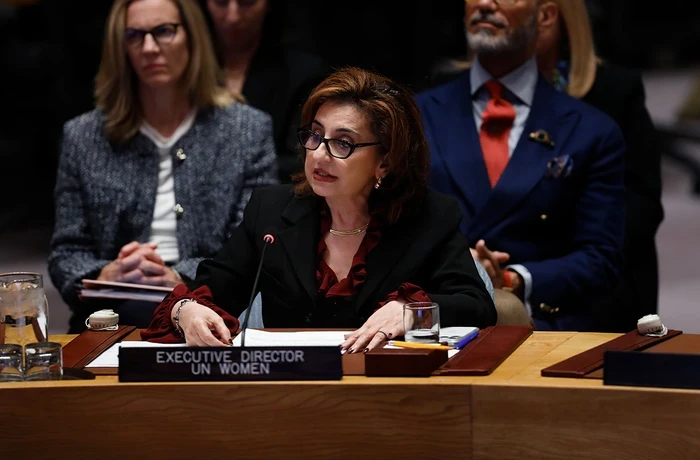
UN Under-Secretary-General and UN Women Executive Director Sima Bahous delivers remarks to the Security Council open debate on women and peace and security, UN headquarters, 27 October 2026. Photo: UN Women/Ryan Brown.
Speech

Speech: Do we have the courage to share power, the resolve to invest in women’s leadership, and the political will to turn our commitments into action?

27 October 2026
Speech: Do we have the courage to share power, the resolve to invest in women’s leadership, and the political will to turn our commitments into action?
Image
UNWomen_Placeholder
Press briefing

The UN Secretary General’s report on Women, Peace, and Security

26 October 2026
The UN Secretary General’s report on Women, Peace, and Security
Image
UNWomen_Placeholder
Press release

Women and girls’ death toll in armed conflict doubles since 2021

26 October 2026
Women and girls’ death toll in armed conflict doubles since 2021

Footer menu-HQ

  • News and stories
  • Resources
  • What we do
  • How we work
  • Where we are
  • Partnerships
  • Employment
  • Procurement
  • Contact us
  • Executive Board
  • Commission on the Status of Women

Donate button menu [Footer tablet]

  • Donate

Donate button menu [Footer]

  • Donate

Social media menu

  • Facebook
  • Twitter
  • LinkedIn
  • Flickr
  • YouTube
  • Instagram
UN Women - For all women and girls

Footer bottom [Menu]

  • Copyright
  • Information security
  • Privacy notice
  • Report wrongdoing
  • Terms of use
Share this page
  • Share to Facebook
  • Share to Twitter
  • Share to LinkedIn
  • Share to E-mail

Or copy link
