
Universal menu

  • Global
  • Regions
    • Africa
    • Americas and the Caribbean
    • Arab States
    • Asia and the Pacific
    • Europe and Central Asia
  • Knowledge
  • Data
  • Training
  • Transparency
UN Women - For all women and girls

Main Navigation-HQ

  • Who we are
    • About us
      • About UN Women
      • Business model
      • Guiding documents
      • Worldwide presence
    • Leadership
      • Governance structure
      • Executive leadership
      • Executive Board
      • Accountability
    • Work with us
      • Employment
      • Procurement
      • Calls for proposals
      • Contact us
      • UN Women Strategic Plan 2026–2029
      • UN Women Strategic Plan 2026–2029 - social media image
        UN Women Strategic Plan 2026–2029
  • What we do
    • Focus areas
      • Ending violence against women
      • Peace and security
      • Humanitarian action
      • Leadership and governance
      • Economic empowerment
      • Innovation and technology
      • Women with disabilities
      • Youth
      • HIV and AIDS
    • How we work
      • 2030 Agenda for Sustainable Development
      • Commission on the Status of Women
      • Gender parity in the UN system
      • Intergovernmental support
      • Partnerships
      • Research and data
      • Training Centre
      • Trust funds
      • UN system coordination
      • Gender Equality Accelerators
      • Gender Equality Accelerators artwork
        Gender Equality Accelerators
  • News and stories
    • Latest
      • News
      • Articles and explainers
      • In focus
    • Media center
      • Press materials
      • Media contacts
      • Explainer: Why are women so exhausted? Care work and the mental load
      • Two adults stand at a table changing diapers on baby dolls, with laundry hanging on a clothesline behind them in a home setting.
        Explainer: Why are women so exhausted? Care work and the mental load
      • Press release: Aid cuts dismantle women’s organizations working in humanitarian crises
      • A young Ugandan woman sits with another local woman to talk
        Press release: Aid cuts dismantle women’s organizations working in humanitarian crises
  • Digital library
    • Resources
      • Publications
      • Annual reports
      • Gender snapshot
      • Progress of the world’s women
      • World survey on the role of women in development
    • GenderTerm
      • GenderTerm
      • Reprint permissions
      • UN Women Highlights 2025–2026
      • A smiling woman.
        UN Women Highlights 2025–2026
      • Gender snapshot 2026
      • A diverse group of people represented as simplified silhouettes, arranged against a dark blue background.
        Gender snapshot 2026
  • Get involved
    • How to get involved
      • For ALL Women and Girls
      • International Women's Day
      • 16 Days of Activism to End Violence against Women and Girls
      • UNiTE! Campaign to End Violence against Women
      • Generation Equality
      • He for She
Ask AI
https://84e5cfacd5c7e99f9825edf344450c.1b.environment.api.powerplatform.com/powervirtualagents/botsbyschema/crad4_websiteQA/directline/token?api-version=2022-03-01-preview
1
-
Ask your question here
AI website assistant

Hello, how can I assist you?

AI chatbot responses may be incorrect. Always verify important information.

Donate button menu

Donate

Breadcrumb

  1. Home
  2. Publications

Website survey

We want to know how we can improve your experience on this website. Completing this survey takes less than 5 minutes.

TAKE THE SURVEY
Image
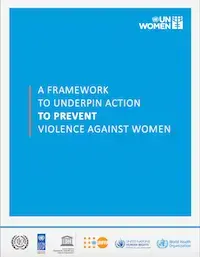
A Framework to underpin action to prevent violence against women

A framework to underpin action to prevent violence against women

Publication year 2015
  • Share to Facebook
  • Share to Twitter
  • Share to LinkedIn
  • Share to E-mail

Violence against women is one of the most pervasive human rights violations in the world, rooted in gender inequality, discrimination and harmful cultural and social norms. It is also increasingly recognized as a public health issue that adversely affects the health of women. It is estimated that approximately 35 per cent of women worldwide have experienced intimate partner physical and/or sexual violence or non-partner sexual violence in their lifetime (WHO, 2013). The prevalence and serious impacts of this violence make it one of the most significant issues to be addressed in our time.

Due to sustained efforts by the women’s movement, governments and other stakeholders, the issue of violence against women is now positioned as a priority on global human rights, health and development agendas. The elimination of all forms of violence against women and girls and of all harmful practices are now part of the 2030 Agenda for Sustainable Development, and included as specific targets (i.e. targets 5.2 and 5.3) in the Sustainable Development Goals, providing a strong mandate for moving forward. Many of the responses to date to violence against women have focused primarily on intervening with affected individuals after the violence has occurred. Such strategies are essential to mitigate the devastating mental, physical, social and economic effects for women experiencing violence, ensure justice and accountability, and prevent its recurrence. It is important to continue to improve these responses. At the same time, there is also an increasing need to address the broader factors that contribute to prevalence at a population level, and to implement programmes that prevent such violence from occurring in the first place.

View online/download

  • Publication in full (en, es, fr)

Order printed/published version

Languages available in print
English, French, Spanish
Order from

Patricia Codazzi

Bibliographic information

Number of pages
60
Resource type(s)
Manuals and tools
Publishing entities
United Nations Entity for Gender Equality and the Empowerment of Women (UN Women) International Labour Organization (ILO) United Nations Development Programme (UNDP) United Nations Educational, Scientific and Cultural Organization (UNESCO) United Nations Population Fund (UNFPA) Office of the United Nations High Commissioner for Human Rights (OHCHR) World Health Organization (WHO)
UN Women office publishing
UN Women Headquarters Office

Tags

Anti-violence interventions Ending violence against women and girls Primary prevention

Related publications

Cover Page

How AI is exacerbating technology-facilitated violence against women and girls

30 December 2025
How AI is exacerbating technology-facilitated violence against women and girls
Global Commitments, local actions

Ending violence against women and girls: Global commitments, local actions

12 December 2025
Ending violence against women and girls: Global commitments, local actions
Publication cover.

Global trends to prevent and respond to technology-facilitated violence against women and girls: A compendium of emerging practices

9 December 2025
Global trends to prevent and respond to technology-facilitated violence against women and girls

Footer menu-HQ

  • News and stories
  • Resources
  • What we do
  • How we work
  • Where we are
  • Partnerships
  • Employment
  • Procurement
  • Contact us
  • Executive Board
  • Commission on the Status of Women

Donate button menu [Footer tablet]

  • Donate

Donate button menu [Footer]

  • Donate

Social media menu

  • Facebook
  • Twitter
  • LinkedIn
  • Flickr
  • YouTube
  • Instagram
UN Women - For all women and girls

Footer bottom [Menu]

  • Copyright
  • Information security
  • Privacy notice
  • Report wrongdoing
  • Terms of use
Share this page
  • Share to Facebook
  • Share to Twitter
  • Share to LinkedIn
  • Share to E-mail

Or copy link