
Universal menu

  • Global
  • Regions
    • Africa
    • Americas and the Caribbean
    • Arab States
    • Asia and the Pacific
    • Europe and Central Asia
  • Knowledge
  • Data
  • Training
  • Transparency
UN Women - For all women and girls

Main Navigation-HQ

  • Who we are
    • About us
      • About UN Women
      • Business model
      • Guiding documents
      • Worldwide presence
    • Leadership
      • Governance structure
      • Executive leadership
      • Executive Board
      • Accountability
    • Work with us
      • Employment
      • Procurement
      • Calls for proposals
      • Contact us
      • UN Women Strategic Plan 2026–2029
      • UN Women Strategic Plan 2026–2029 - social media image
        UN Women Strategic Plan 2026–2029
  • What we do
    • Focus areas
      • Ending violence against women
      • Peace and security
      • Humanitarian action
      • Leadership and governance
      • Economic empowerment
      • Innovation and technology
      • Women with disabilities
      • Youth
      • HIV and AIDS
    • How we work
      • 2030 Agenda for Sustainable Development
      • Commission on the Status of Women
      • Gender parity in the UN system
      • Intergovernmental support
      • Partnerships
      • Research and data
      • Training Centre
      • Trust funds
      • UN system coordination
      • Gender Equality Accelerators
      • Gender Equality Accelerators artwork
        Gender Equality Accelerators
  • News and stories
    • Latest
      • News
      • Articles and explainers
      • In focus
    • Media center
      • Press materials
      • Media contacts
      • Explainer: Why are women so exhausted? Care work and the mental load
      • Two adults stand at a table changing diapers on baby dolls, with laundry hanging on a clothesline behind them in a home setting.
        Explainer: Why are women so exhausted? Care work and the mental load
      • Press release: Aid cuts dismantle women’s organizations working in humanitarian crises
      • A young Ugandan woman sits with another local woman to talk
        Press release: Aid cuts dismantle women’s organizations working in humanitarian crises
  • Digital library
    • Resources
      • Publications
      • Annual reports
      • Gender snapshot
      • Progress of the world’s women
      • World survey on the role of women in development
    • GenderTerm
      • GenderTerm
      • Reprint permissions
      • UN Women Highlights 2025–2026
      • A smiling woman.
        UN Women Highlights 2025–2026
      • Gender snapshot 2026
      • A diverse group of people represented as simplified silhouettes, arranged against a dark blue background.
        Gender snapshot 2026
  • Get involved
    • How to get involved
      • For ALL Women and Girls
      • International Women's Day
      • 16 Days of Activism to End Violence against Women and Girls
      • UNiTE! Campaign to End Violence against Women
      • Generation Equality
      • He for She
Ask AI
https://84e5cfacd5c7e99f9825edf344450c.1b.environment.api.powerplatform.com/powervirtualagents/botsbyschema/crad4_websiteQA/directline/token?api-version=2022-03-01-preview
1
-
Ask your question here
AI website assistant

Hello, how can I assist you?

AI chatbot responses may be incorrect. Always verify important information.

Donate button menu

Donate

Breadcrumb

  1. Home
  2. Publications

Website survey

We want to know how we can improve your experience on this website. Completing this survey takes less than 5 minutes.

TAKE THE SURVEY
Image
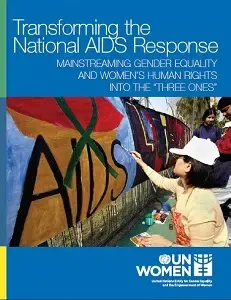
Cover page - Transforming the National AIDS Response

Transforming the national AIDS response: Mainstreaming gender equality and women’s human rights into the ‘Three Ones’

Publication year 2012
  • Share to Facebook
  • Share to Twitter
  • Share to LinkedIn
  • Share to E-mail
Author(s)/editor(s) Patricia Made; coordinated by Nazneen Damji, with contributions and research by Nazneen Damji, Neetu John, Aida Olkkonen, and Ana Williams

Statistics on HIV and AIDS present a stark reality. Today, after over 25 years of working to combat this pandemic, over 30 million people are living with HIV, half of them women. Women’s infection rates are rising, often dramatically, outpacing those of men in many countries particularly in sub-Saharan Africa.

Unless national and global responses to the pandemic accelerate, these trends project a bleak vision of the future: more and more women infected; still more exhausted from caring for the ill and dying; children left to fend for themselves or rely on their elderly grandparents. The changing face of the disease means that women, especially young women, will continue to be the most vulnerable to infection, the least able to protect themselves and the last to get treatment and care. Widows will continue to be driven from their homes in many places, deprived of land and inheritance rights; the number of AIDS orphans will continue to grow; and families will have little hope of getting out of poverty.

Women have been warning about this future for years. Over a decade ago, they saw what was happening, especially in Africa, and began speaking out. Supported by UN Women and others, they have been working tirelessly to place gender inequality and HIV on national and international agendas—demanding greater attention to the ways in which gender discrimination and violence help to fuel the spread of HIV, and its dreadful consequences in terms of lives and hopes.

Ultimately, there is no quick fix. The single most important strategy in preventing the spread of HIV and AIDS is empowering women and girls and guaranteeing their rights to prevention, treatment, care and support. But there are other important strategies and actions that can be taken, at different levels, to eliminate the myriad barriers that keep them from exercising these rights.

This resource guide provides examples of national strategies, from transforming national and local institutions in order to break through the silence and stigma that surround AIDS and HIV, to working with communities to change attitudes and behaviours that facilitate its spread. They show what can be done when women and men living with HIV are engaged and empowered to make their needs heard and to help design solutions.
View online/download

  • PDF version (en, es, fr)

Bibliographic information

Number of pages
38
Resource type(s)
Manuals and tools
ISBN
1932827-64-1
Publishing entities
United Nations Entity for Gender Equality and the Empowerment of Women (UN Women)
UN Women office publishing
UN Women Headquarters Office

Tags

Africa Care and support services Gender mainstreaming Governance and national planning HIV and AIDS Human rights Prevention Treatment

Related publications

Financing for gender equality in the HIV response

Financing for gender equality in the HIV response

18 October 2021
Financing for gender equality in the HIV response
Key barriers to women’s access to HIV treatment: A global review

Key barriers to women’s access to HIV treatment: A global review

12 December 2017
Key barriers to women’s access to HIV treatment: A global review
Women in the diplomatic corps: Normative frameworks, structural barriers and policy recommendations

Women in the diplomatic corps: Normative frameworks, structural barriers and policy recommendations

24 February 2026
Women in the diplomatic corps: Normative frameworks, structural barriers and policy recommendations

Footer menu-HQ

  • News and stories
  • Resources
  • What we do
  • How we work
  • Where we are
  • Partnerships
  • Employment
  • Procurement
  • Contact us
  • Executive Board
  • Commission on the Status of Women

Donate button menu [Footer tablet]

  • Donate

Donate button menu [Footer]

  • Donate

Social media menu

  • Facebook
  • Twitter
  • LinkedIn
  • Flickr
  • YouTube
  • Instagram
UN Women - For all women and girls

Footer bottom [Menu]

  • Copyright
  • Information security
  • Privacy notice
  • Report wrongdoing
  • Terms of use
Share this page
  • Share to Facebook
  • Share to Twitter
  • Share to LinkedIn
  • Share to E-mail

Or copy link